Code: 10305
Dimensions:
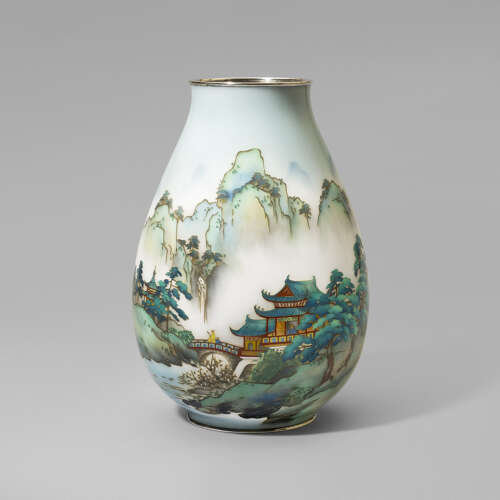
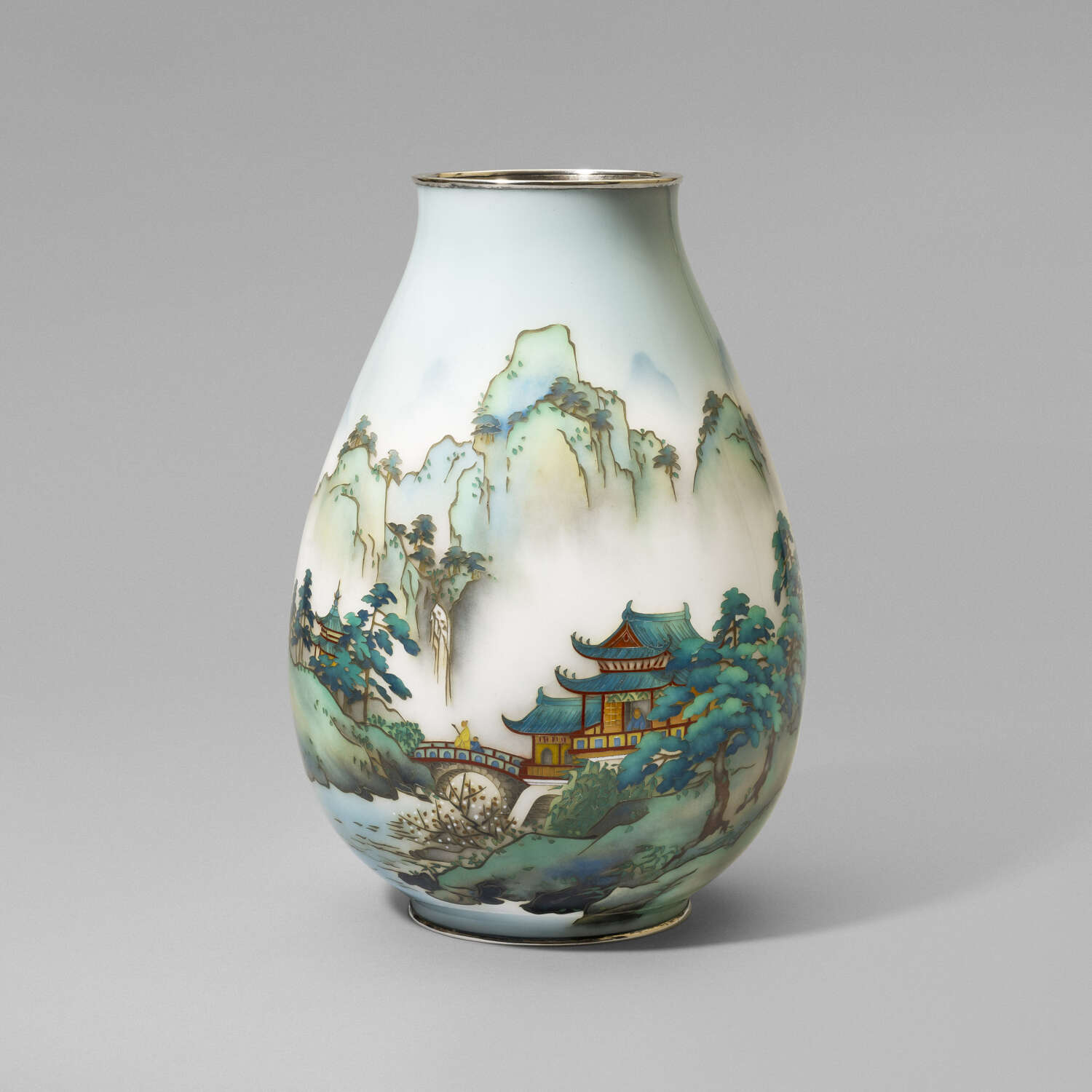
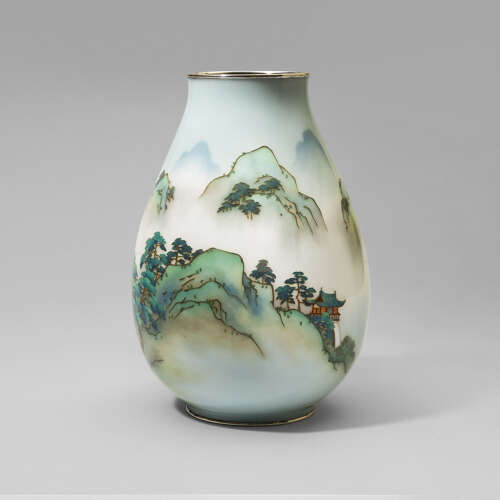
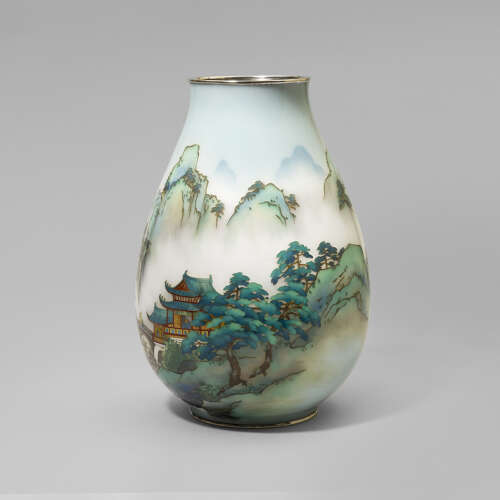
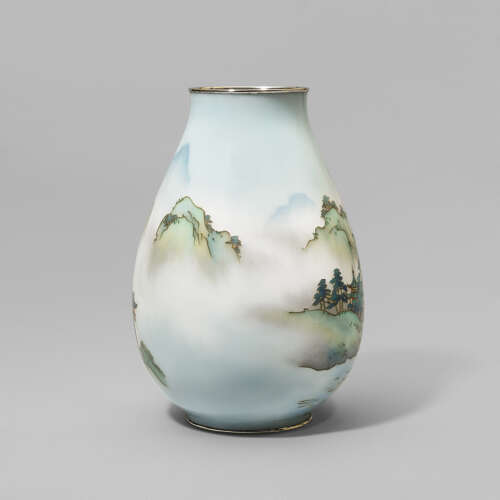
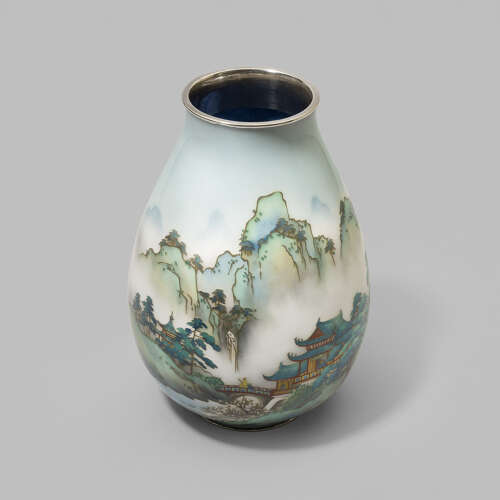
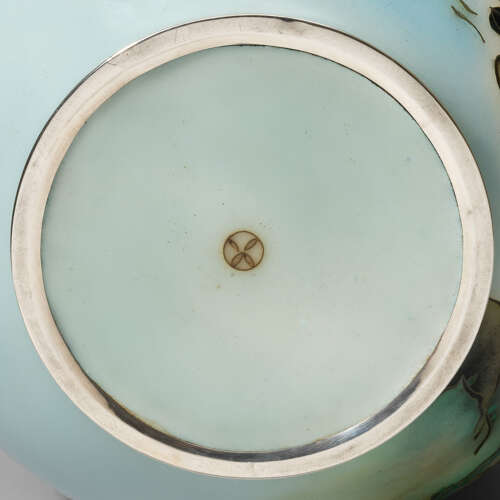
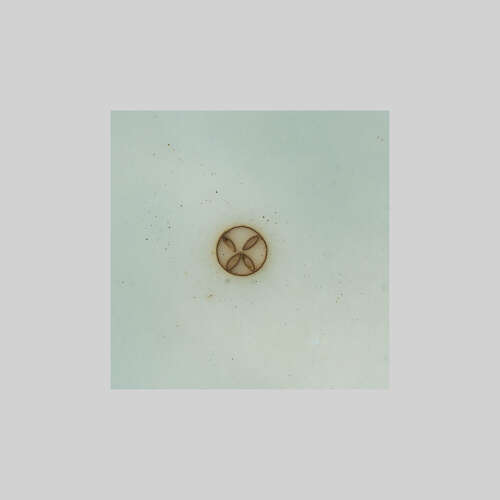
Japanese cloisonné enamel vase of baluster form, finely worked in silver wire with a tranquil scene of temples nestled among mist shrouded mountains. Pine covered slopes rise through drifting veils of clouds, while a waterfall cascades into the depths below. In the foreground figures cross a bridge spanning a stream, all set against a softly graduated celadon ground and applied with silver mounts. The work reflects the mastery of pictorial cloisonné techniques adapted here to a quieter, more contemplative aesthetic, characteristic of early twentieth-century Japanese decorative arts. The floating, atmospheric space recalls traditional Chinese paintings and also reflects the Japanese nanga aesthetic associated with Tani Bunchō. The base bears the silver yūsen mark of Andō Jūbei 安藤重兵衛, Shōwa period c.1940.
The Andō Cloisonné Company was founded in 1880 by Maeda Matsukichi 前田松吉 and later expanded through the involvement of Andō Juzaburō, known as Andō Jūbei I 安藤重兵衛 (1876–1953). By the early 1890s, the company had already achieved notable recognition, with several of its works purchased by the Imperial Household in 1891 and 1892. Throughout the Meiji and Taishō periods, Andō emerged as one of Japan’s leading enamel workshops, receiving medals at numerous international expositions, including the World’s Columbian Exposition in Chicago (1893), the Exposition Universelle in Paris (1900), the Glasgow International Exhibition (1901), the Louisiana Purchase Exposition in St. Louis (1904), the Japan–British Exhibition in London (1910), and the Sesqui-Centennial International Exposition in Philadelphia (1926).
Reference: 'The Art of Japanese Cloisonné Enamel: History, Techniques and Artists, 1600 to the Present', by Frederich T. Schneider, North Carolina, 2010, p. 241 no.4.
'Meiji no Takara 明治の宝: Treasures of Imperial Japan, the Nasser D. Khalili Collection', the Kibo Foundation 1995, Enamel Vol. III, no. 53.
All our pieces come with a BADA Certificate of Provenance (The British Antiques Dealer's Association) and are inclusive of free U.K. shipping & insurance. Please inquiry for International shipping.