Code: 10276
Dimensions:
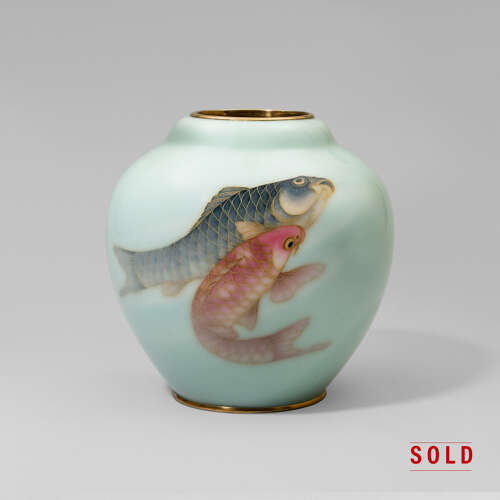
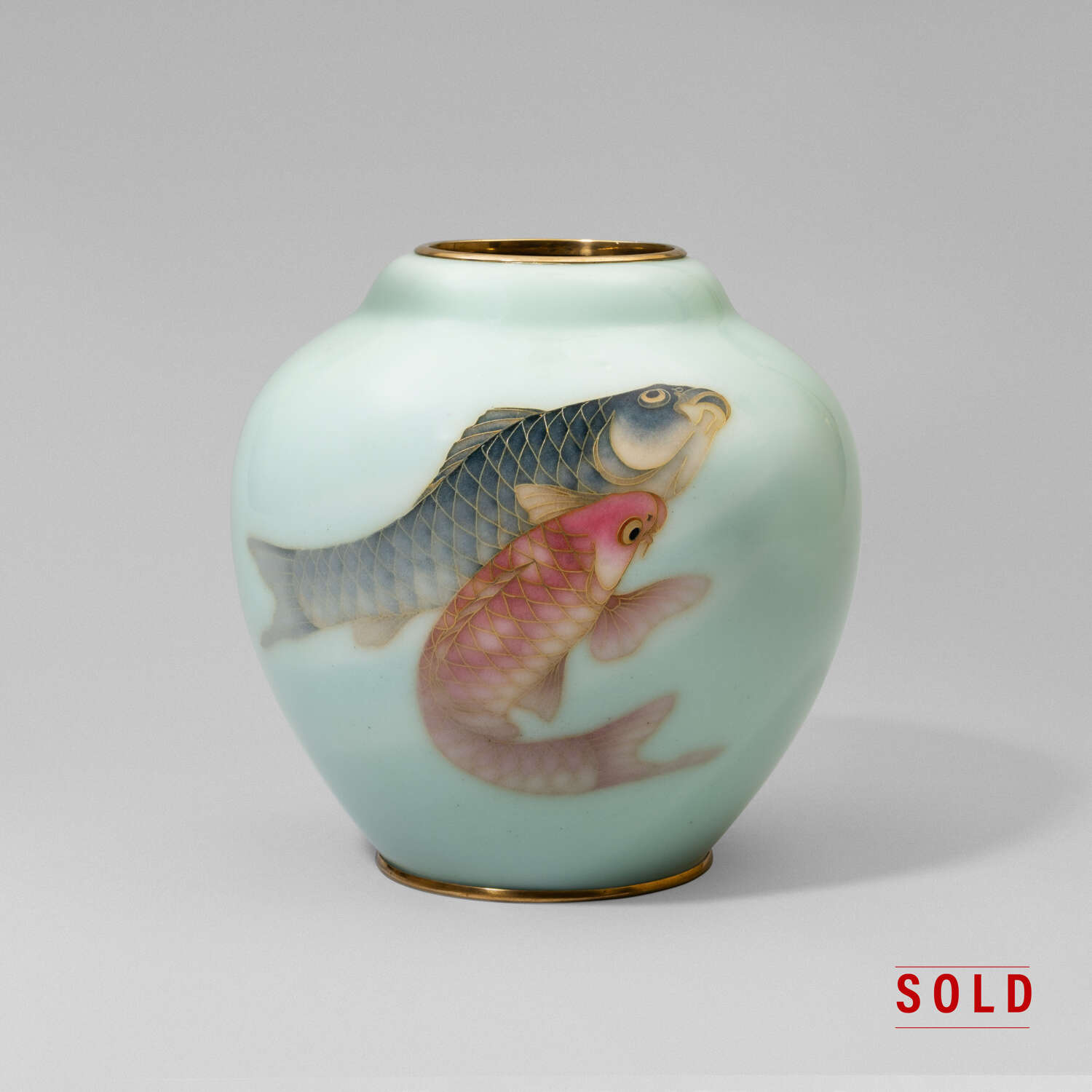
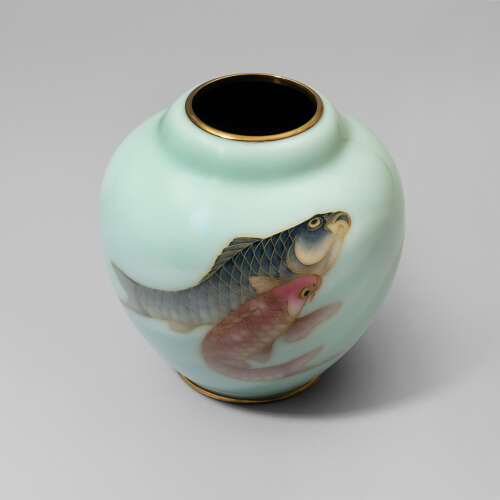
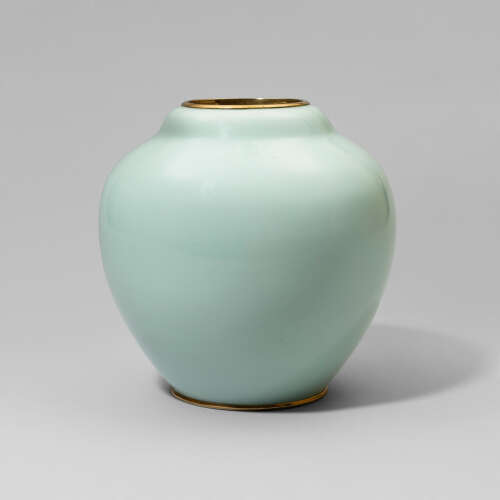
Japanese cloisonné enamel vase of globular form, combining gold wire and musen (wireless) techniques, richly decorated in polychrome enamels with two koi carp swimming through water. The fish are rendered with exceptional naturalism: their scales are meticulously detailed in fine wire, while the submerged portions of their bodies dissolve seamlessly into areas of musen enamel, creating a sense of depth and movement beneath the surface. The design is set against a soft pale celadon ground, applied with a gilt rim and foot. The base is inlaid with the yūsen mark of Andō Jūbei 安藤重兵衛, Shōwa period.
The koi (nishikigoi 錦鯉) symbolizes courage, determination, and resilience in the face of adversity. Originally introduced to Japan from China in the 1st century A.D. as a food source, koi were later bred by Japanese farmers in the late 19th century for their striking colors. Over time, these ornamental fish became cherished and highly valued.
Numerous legends surround the koi, the most famous being the tale of the 'Dragon Gate Waterfall'. According to the story, thousands of koi swim upstream along the Yellow River, battling powerful currents. Those strong enough to reach the top of the great waterfall are transformed into dragons. This legend teaches that perseverance and determination can help overcome life’s greatest challenges.
The Andō Cloisonné Company was established in 1880 by Maeda Matsukichi (前田松吉) and later developed further under Andō Juzaburō, better known as Andō Jūbei I (1876-1953). By the early 1890s, the firm had gained significant acclaim, with several pieces acquired by the Imperial Household in 1891 and 1892.
During the Meiji (1868-1912) and Taishō (1912-1926) eras, Andō became one of Japan’s foremost enamel studios, earning awards at major international exhibitions. These included the World’s Columbian Exposition in Chicago (1893), the Exposition Universelle in Paris (1900), the Glasgow International Exhibition (1901), the Louisiana Purchase Exposition in St. Louis (1904), the Japan–British Exhibition in London (1910), and the Sesqui-Centennial International Exposition in Philadelphia (1926).
Reference: ‘The Art of Japanese Cloisonné Enamel: History, Techniques and Artists, 1600 to the Present’, by Frederich T. Schneider, North Carolina, 2010.
All our pieces come with a BADA Certificate of Provenance (The British Antiques Dealer's Association) and are inclusive of free U.K. shipping & insurance. Please inquiry for International shipping.