Code: 10256
Dimensions:
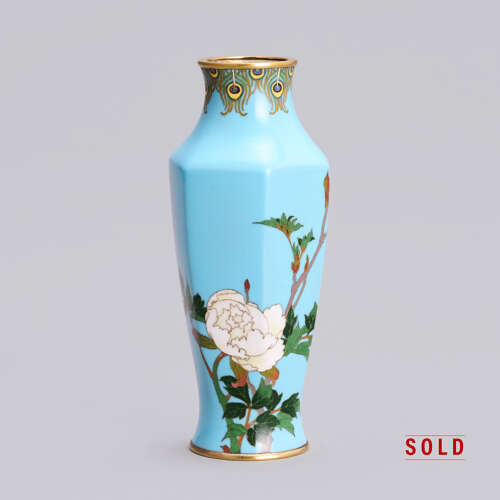
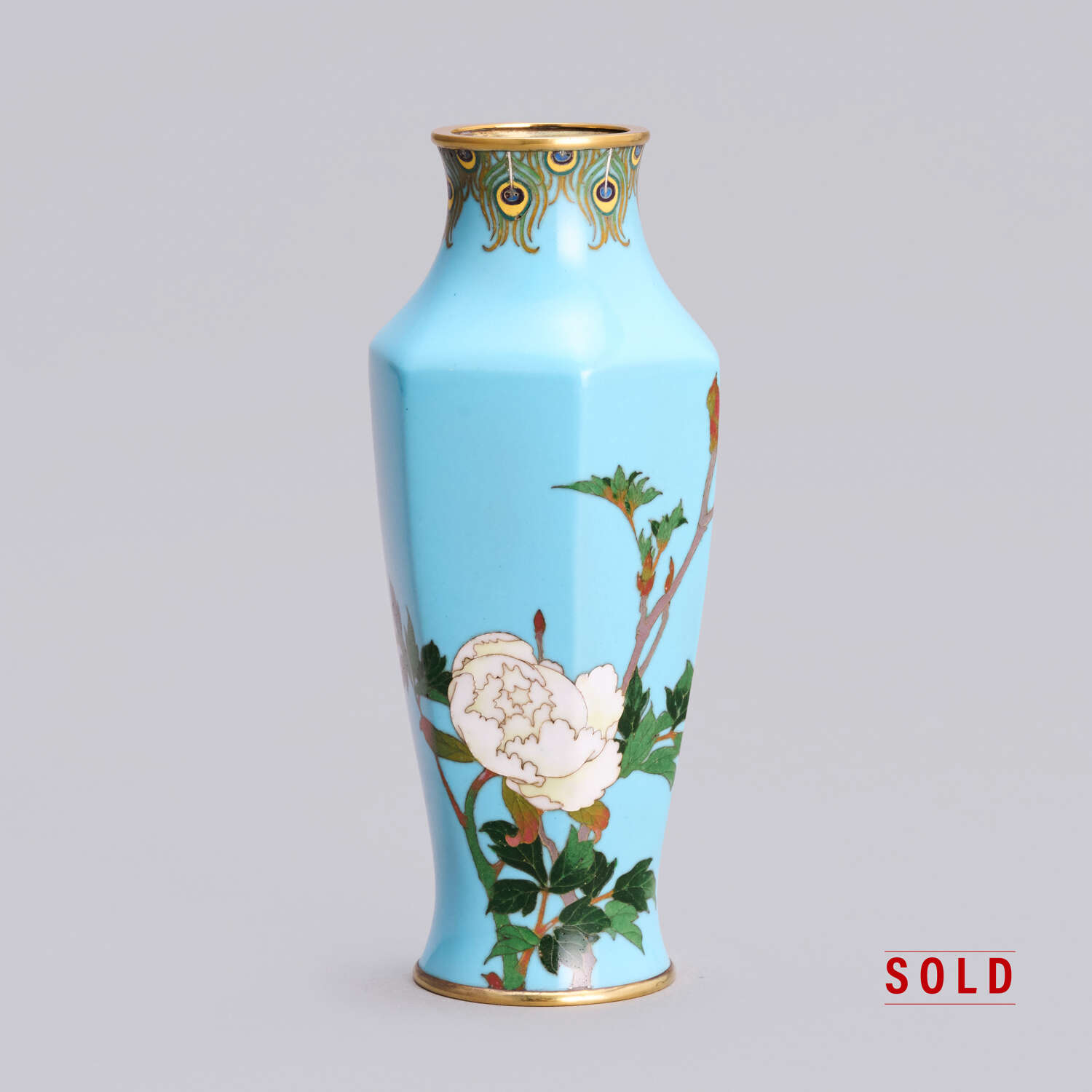
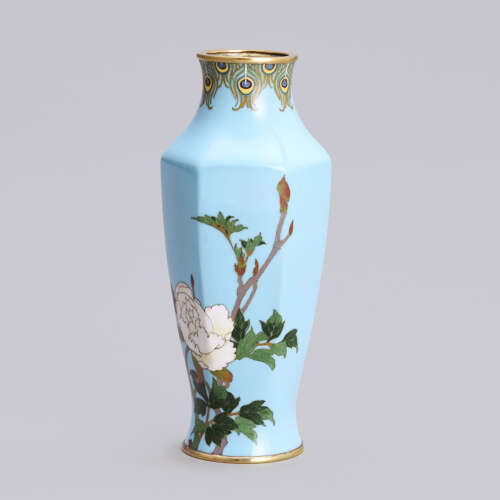
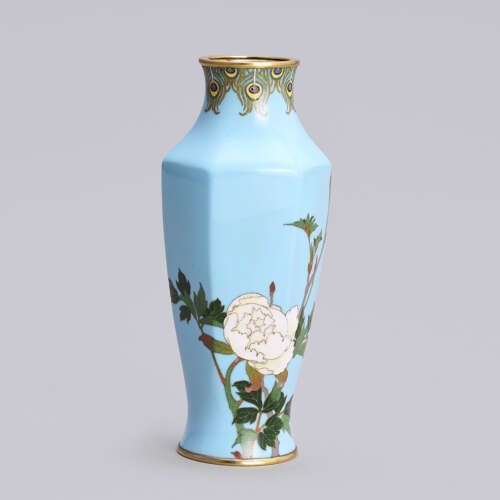
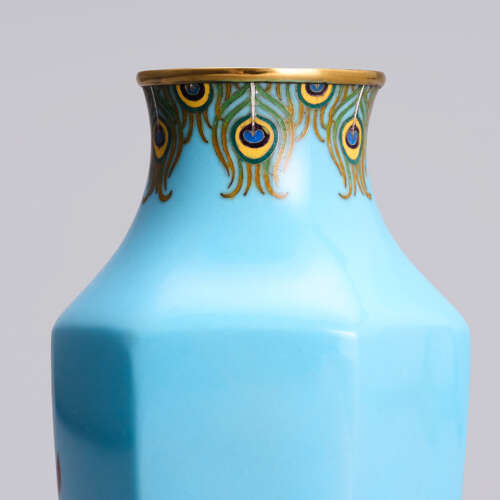
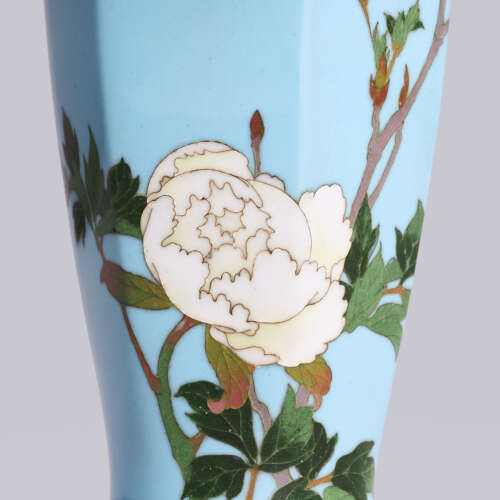
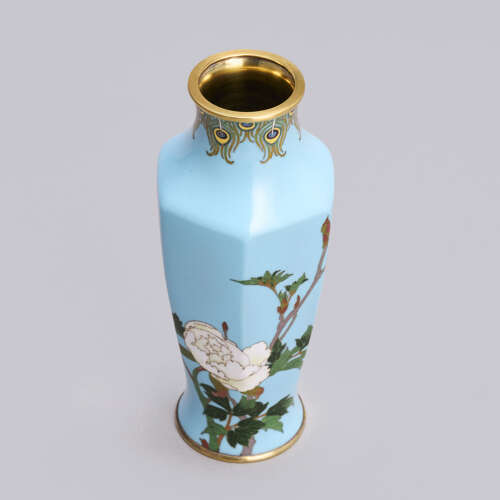
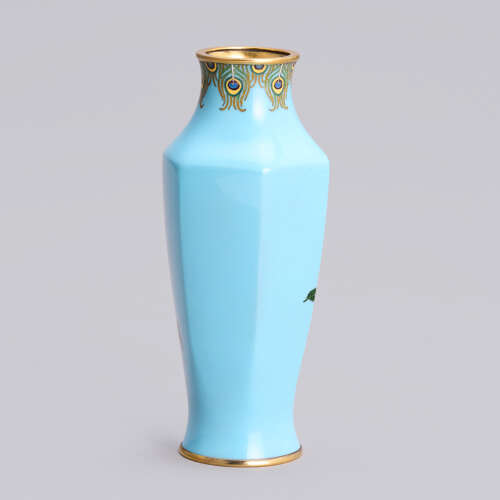
Japanese cloisonné enamel vase of hexagonal form worked in gold wire decorated with a white peony in bloom on a light turquoise ground, applied with gilt mounts.
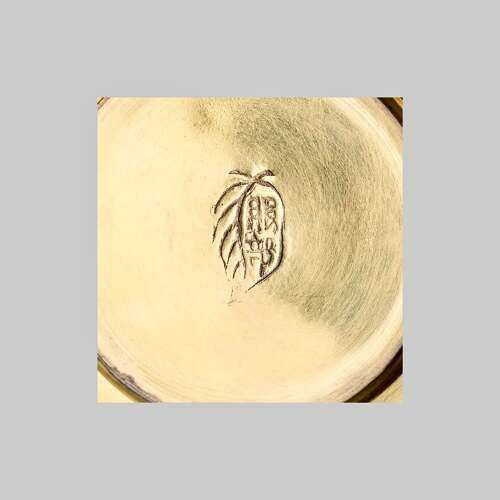
The neck with a band of stylised peacock feathers motifs, stamped with the two characters daikon’s leaf shape mark of Hattori Tadasaburō,Taishō period (1912-1926).
Hattori Tadasaburō 服部唯三郎 was trained by Tsukamoto Jin’emon and in 1888 opened his own studio at no. 80 Shimosono-machi in Nagoya. He first showed moriage pieces (piled-up cloisonné technique where enamels are layered onto others prior to a last firing) at the Saint Louis 1904 Louisiana Purchase Exposition.
This technique first appeared at the Osaka 1903 Fifth Domestic Exposition on pieces exhibited by Kawade Shibatarō and the Andō Company.
In 1893 he won a medal at the Chicago World’s Columbia Exposition. In 1904 he was awarded silver and bronze medals at the Louisiana Purchase Exposition in St. Louis, and a silver medal at the Liege Exposition. He also exhibited at the London Japan-British Exposition in 1910.
In 1914 he was referred to in the Imperial Japanese Government Railways' Official Guide as "one of five living master enamel makers", alongside Namikawa Yasuyuki, Namikawa Sosuke, Andō and Ōta. He was also appointed to the prestigious ranks of Teishitsu Gigeiin (Artist-Craftsmen to the Imperial Household).
Many of his works are in the Victoria & Albert Museum’s collections in London.
Reference: ‘The Art of Japanese Cloisonné Enamel: History, Techniques and Artists: 1600 to the Present’, by Frederic T. Schneider, Jefferson N.C., McFarland & Company, Inc., 2010, pg.202-203, and p.243 no. 36.
‘Japanese Cloisonné Enamels: The Seven Treasures’, by Gregory Irvine, London, Victoria and Albert Museum, 2006, p.127.
All our pieces come with a BADA Certificate of Provenance (The British Antiques Dealer's Association) and are inclusive of free U.K. shipping & insurance. Please inquiry for International shipping.