

Code: 10306
Dimensions:
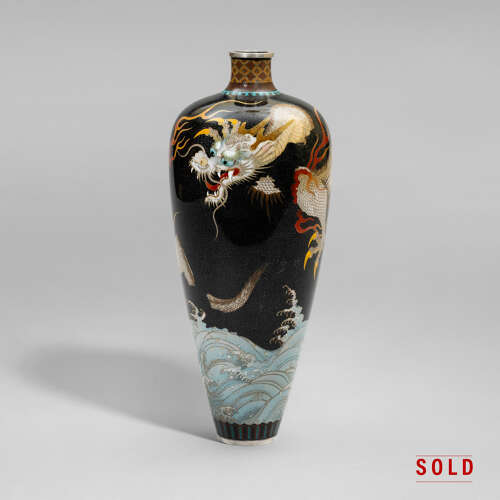
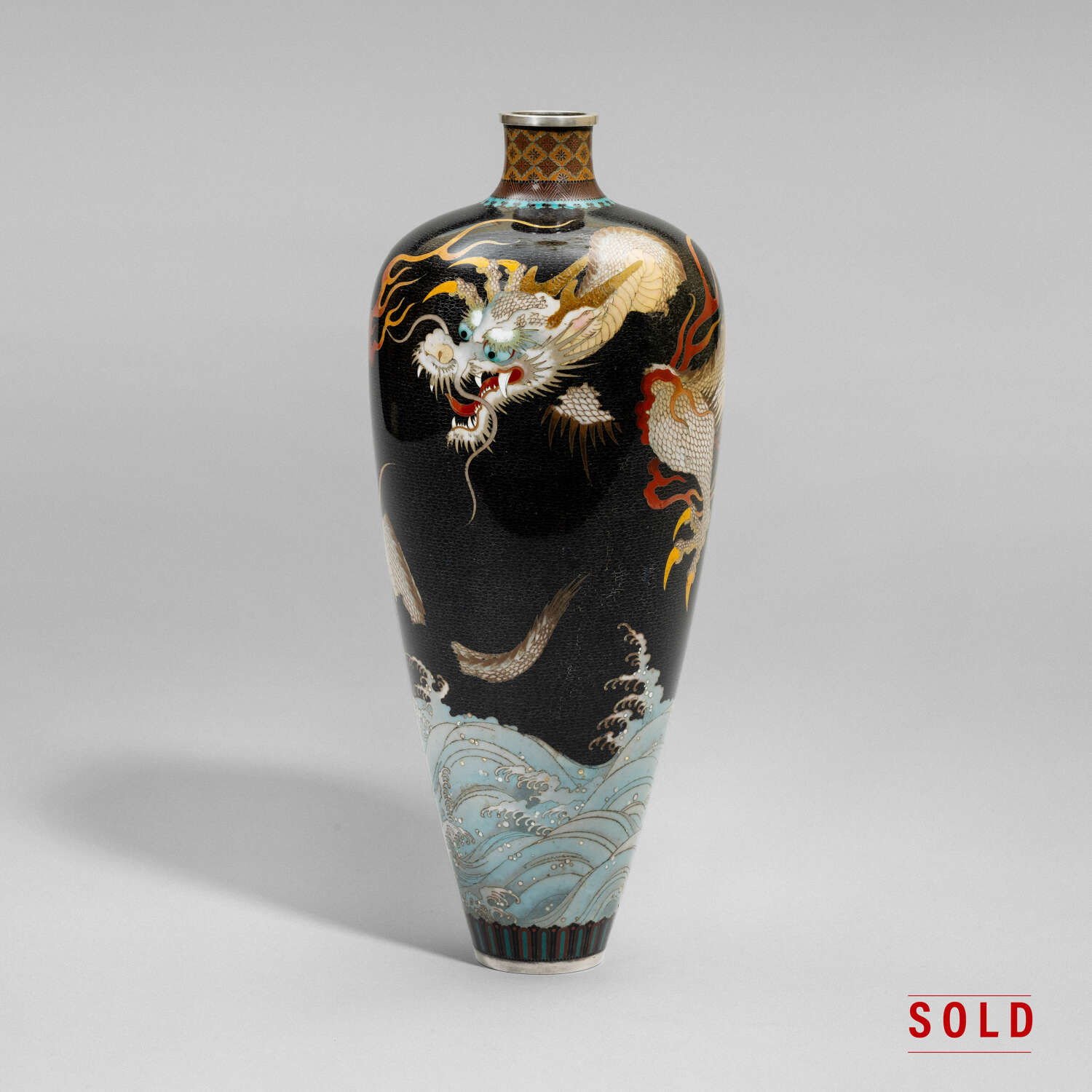
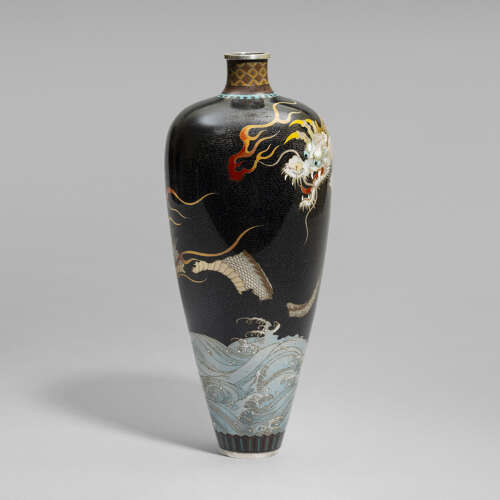
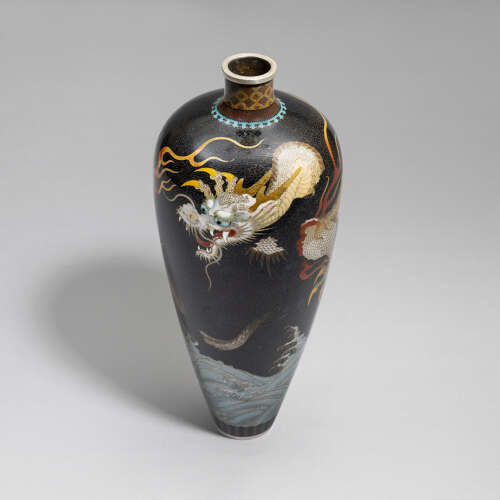
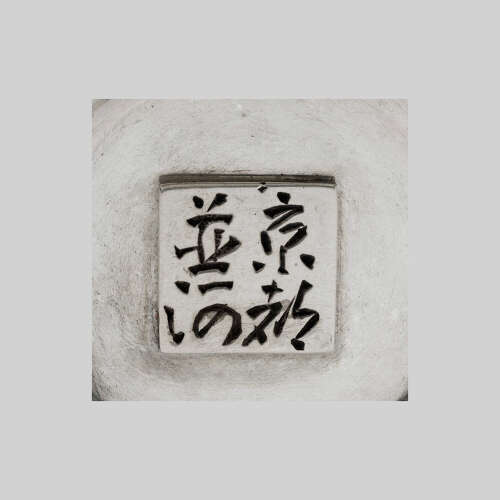
Japanese cloisonné enamel vase of elongated baluster form with a narrow neck, decorated with a writhing dragon in flight above blue crushing waves with white droplets of foam against a black ground densely worked with silver-wire cloud scrolls. The dragon’s sinuous movement is accentuated by surrounding flames and finely detailed scales, claws, whiskers, and horns. The neck with a stylised floral motifs and the foot with a band of lappets applied with silver rims. The base signed on a silver tablet Kyoto Namikawa 京都 並河 (Namikawa Yasuyuki) late Meiji period 1868-1912.
The dragon (tatsu 辰/ryū 龍) is one of the twelve Zodiac signs and is a water deity symbolic of power, wealth and prosperity. The mythological animal has three claws on each foot, while the Chinese dragon has four or five claws. Dragon motifs are found in Buddhist temples and Shinto shrines and are often represented holding the sacred jewel in their fore claw, suggestive of the many legends that enrich Japanese mythology.
Namikawa Yasuyuki 並河靖之(1845-1927) is regarded as one of Japan’s foremost cloisonné enamel masters, celebrated for elevating shippō to unprecedented artistic and technical sophistication. Shippō 七宝 lit. “seven treasures”, refers to the highly refined art of cloisonné enamel, renowned for its jewel-like brilliance and intricate decoration. The technique involves shaping fine metal wires into delicate compartments (cloisons) on a copper, silver, or bronze base, which are then filled with coloured enamel pastes. Through repeated firings and meticulous polishing, artisans achieve a luminous surface distinguished by exceptional depth and clarity encompassing serene landscapes, floral and fauna subjects, geometric and symbolic motifs. Namikawa Yasuyuki began his career as a samurai under the Tokugawa shogunate before turning to cloisonné production in the early Meiji period, a time of rapid modernisation and global cultural exchange. Establishing his Kyoto studio in 1873, Namikawa rose to prominence by the 1880s with a team of skilled artisans and a dedicated showroom for private clients. He was particularly admired for his innovations in colour gradation and for developing techniques that produced remarkably smooth, glass-like finishes. His works often feature elegant botanical and ornithomorphic designs inspired by traditional Japanese aesthetics, combined with innovative compositions that appealed to international audiences. He exhibited widely at world expositions, earning global accolades including eleven awards between 1876 and 1904 and prestigious commissions from the Imperial Household Agency. In 1896, he was appointed Teishitsu Gigeiin (Artist-Craftsman to the Imperial Household), one of the highest honours for an artist of the period. By the late 19th century, his Kyoto workshop had become a center of excellence, establishing Namikawa as a key figure in transforming Japanese cloisonné into a celebrated art form worldwide.
Reference: 'The Art of Japanese Cloisonné Enamel: History, Techniques and Artists, 1600 to the Present', by Frederich T. Schneider, North Carolina, McFarland, 2010, p. 251 no. 138.
'Meiji no Takara 明治の宝: Treasures of Imperial Japan, the Nasser D. Khalili Collection', the Kibo Foundation 1995, Enamel Vol. III, no. 6.
All our pieces come with a BADA Certificate of Provenance (The British Antiques Dealer's Association) and are inclusive of free U.K. shipping & insurance. Please inquiry for International shipping.