
Silver prices have rocketed recently and certainly the demand for fine Japanese objects has remained strong. The appeal of silver is in the skill of the craftsmanship and the seemingly infinite patience of the craftsman, the tactile experience of handling these objects, and also the poignancy and charm of the many subjects. Many tales of heroes, animals, gods, goddesses give us a glimpse into this fascinating culture.
People all over the world are captivated by the beauty of Japanese art, but is also the mythical and mysterious in their forms that is most appealing and enchanting. There is always so much more than meets the eye when you look at Japanese art, the symbolism and mythology are deeply embedded and the appreciation of these subtleties can add greatly to their enjoyment.
I have noticed an increased interest from a younger generation of new collectors, and get a lot of pleasure to interact with them and help them to develop their knowledge in this art. This way I am ensuring that these beautiful artefacts will be preserved for the future, after all I am simply a temporary curator of these pieces. I meet very interesting and fascinating people from all walks of life and share with them this passion for these beautiful objects.
It is also important to recognise the influence that Japanese Art has had on the West. During the second half of the 19th century Japan came out of relative isolation after 250 odd years, until this time foreign trade had been strictly controlled and limited to the Dutch and Chinese. In 1868 with the Meiji (enlightened rule) era, the young Emperor Mutsuhito began a process of radical social and economic reforms, which promoted Japanese craftsmen and industrial designers with great success through the International exhibitions in Europe and America. Japanese craftsmanship gained recognition by many scholars and collectors in the West who were soon captivated by these objects starting a fashion for all things coming from the exotic land of the ‘Rising Sun’.
This frenzy to collect Japanese art started a trend known as Japonisme, in particular the ukiyo-e woodblock prints inspired the Impressionist painters and the early Art Nouveau movement. Artists like Paul Gaugin, Camille Pissarro, Edgar Degas, Monet and Vincent van Gogh were influenced by the boldness of the colours, the Japanese asymmetry and composition. Also many elements of Japanese aesthetics were adopted into European decorative arts, paintings, textiles and furniture. The Scottish architect and designer Charles Rennie Mackintosh admired the simple forms and the use of natural materials. The iconic designer Christopher Dresser significantly contributed to the Anglo-Japanese movement in Britain, taking inspiration from Japanese designs.
Take for example this exquisite silver and shibuichi box by the master Ishikawa Katsunobu 石川 勝信 which is finely inlaid in gold, silver and shakudo, illustrated with two cranes on a shore among pine trees and crashing waves beneath a rising sun, Meiji period (1868-1912).The composition is well thought out and beautifully balanced.
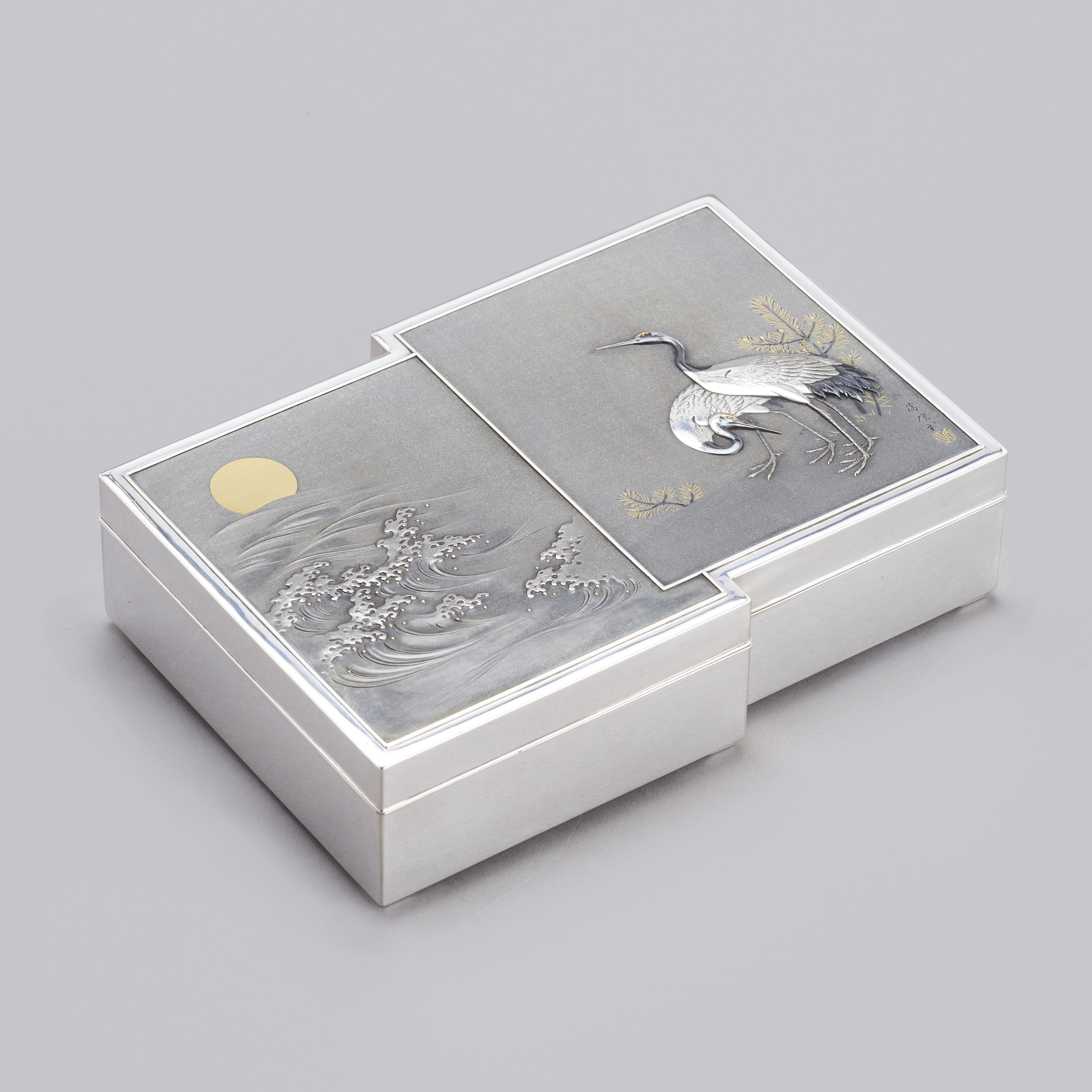
Ishikawa Katsunobu 石川 勝信 was one of the most talented metalworkers of his time, also known by his go (art name) Chishinsai 知新斎. He was born in 1869 in Mito, Ibaragi Prefecture northeast of Tokyo, and in 1882 was apprenticed to Namekawa Sadakatsu and Unno Shomin. He later started to work on his own in 1890 and lived in Atagoshita district, Tokyo. He exhibited two pieces at the Paris Exposition Universelle in 1900, see Tokyo Kokuritsu Bunka-zai Kenkyujo (Tokyo National Research Institution of Cultural Properties), Meijiki bankoku haku- rankai bijutsuhin shuppin mokuroku (Catalogues of objects exhibited at International Expositions in the Meiji Era),Tokyo, Chuokoron Bijutsu Shuppan, 1997, nos. Q168, R818. He also exhibited at many International exhibitions including the Japan-British Exposition in 1910. His work was commissioned by the Hattori Clock Company, an upscale emporium in the Ginza district, and the Mitsukoshi Department store in Nihonbashi. He was appointed an Imperial Court Artist (Teishitsu Gigeiin) in 1896.
The red-crowned crane (tancho-zuru) is a tall graceful bird. In Japan is an auspicious symbol of long life because of its fables life span of a thousand years, luck and fidelity as cranes pair for life. This bird does usually accompany the God Jurojin one of the Seven Gods of Good Fortune known collectively as the Shichifukujin (Seven Happiness beings).
The crane motif is featured in boxes, vases, bronze sculptures, porcelain, screens, paintings, woodblock prints and scrolls. The Art Nouveau movement adopted the crane as one of their favourite animal motif. Because of their happy connotation cranes were often depicted in the walls of temples and homes.
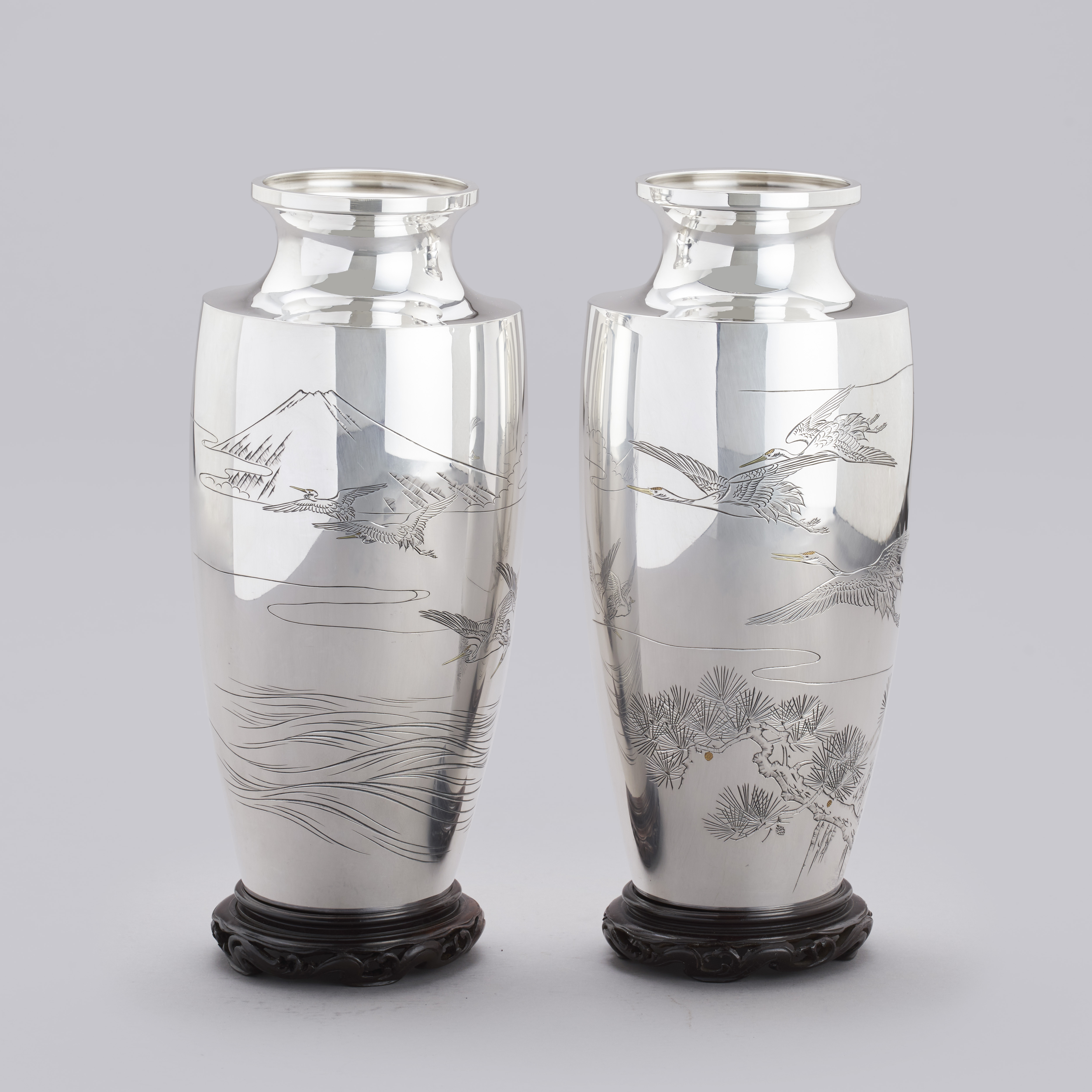
And also this pair of silver vases, each with a slender baluster shape finely carved in katakiri-bori (a technique using an angular chisel to achieve a thick and thin effect to imitate brush strokes) with flying cranes above pine trees and Mount Fuji rising through in the distance, signed to the body Bishun koku 美春刻 (engraved by Bishun) and stamped to the underside with the mark Jungin 純銀 (pure silver) and Kobayashi sei 小林製 (made by Bishun Kobayashi for the Kobayashi Company) with silk lined bag and hardwood stands, Taisho period 1912-1926. Kobayashi Bishun 小林美春 was active in the Meiji and Taishō and is listed in the Toso Kinko Jiten by Wakayama Takeshi pg. 530. His given name was Daiyu (Daisuke) and lived and worked in Osaka and Tottori. His father was Kobayashi Shunko also an artist skilled in metalwork and cloisonné enamels. The Kobayashi Clock Company was based in Tokyo and produced fine metalwork.
Mount Fuji (Fujisan) is Japan’s most sacred mountain located in the Fuji-Hakone-Izu National Park which was declared in 2013 a UNESCOWorld Heritage Site. Considered as holy ground for Japanese pilgrims, the mountain has been awe-inspiring for centuries to foreign visitors.The iconic Fuji has been reproduced in Japanese art, most notably in the series of landscape prints the ‘Thirty- six views of Mount Fuji ' by the famous ukiyo-e artist Katsushika Hokusai, published between 1826 and 1832.
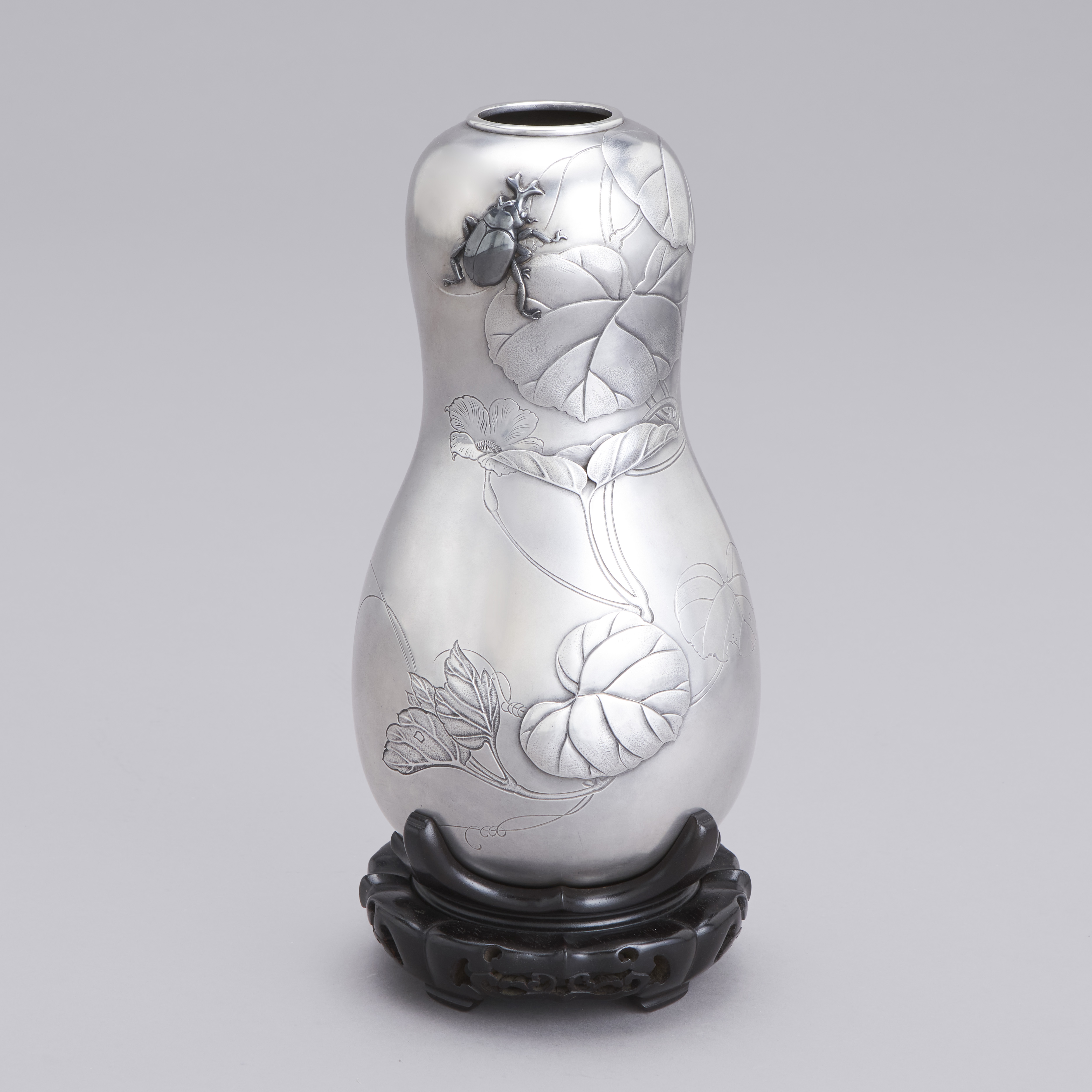
And lastly this silver gourd vase with a climbing stag beetle up the side finely carved with paulownia leaves and flowers, inlaid with details in shibuichi signed Hojo 芳乗 with a round seal Toshu 藤州 and under the base Chorakusai 長禾斎 with Jungin mark 純銀 (pure silver) original wood stand, Shōwa period circa 1945.
Ando Hojo 安藤芳乗 was born in 1910 in Kagoshima Prefecture. In 1934 he graduated from the Metal engraving Art Department (Chokin) of the Tokyo University of Fine Art.
The gourd (fukube/hyotan 瓢) form is a popular subject in Japanese art objects and is very appealing especially with insects like the stag beetle (kabutomushi カブトムシ).
The symbolism of the beetle dates back to ancient times across many different cultures. In Japanese art is a good omen, symbolic of abundance and good fortune coming into your life and it is linked with the hearth suggesting to stay strong in your convictions.
Laura Bordignon is the author of 'The Golden Age of Japanese Okimono' (Antique Collectors' Club 2010) an essential reference work for collectors, connoisseurs, dealers and scholar alike.