Code: 10320
Dimensions:
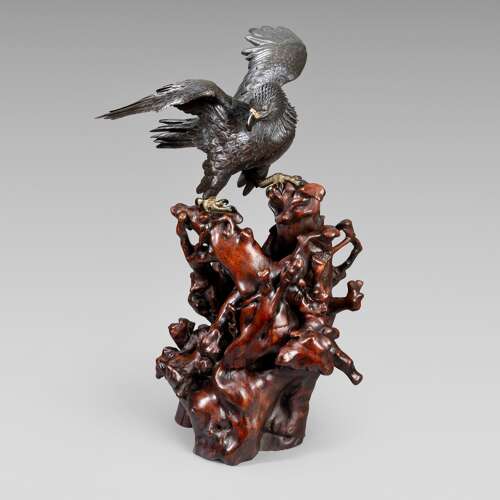
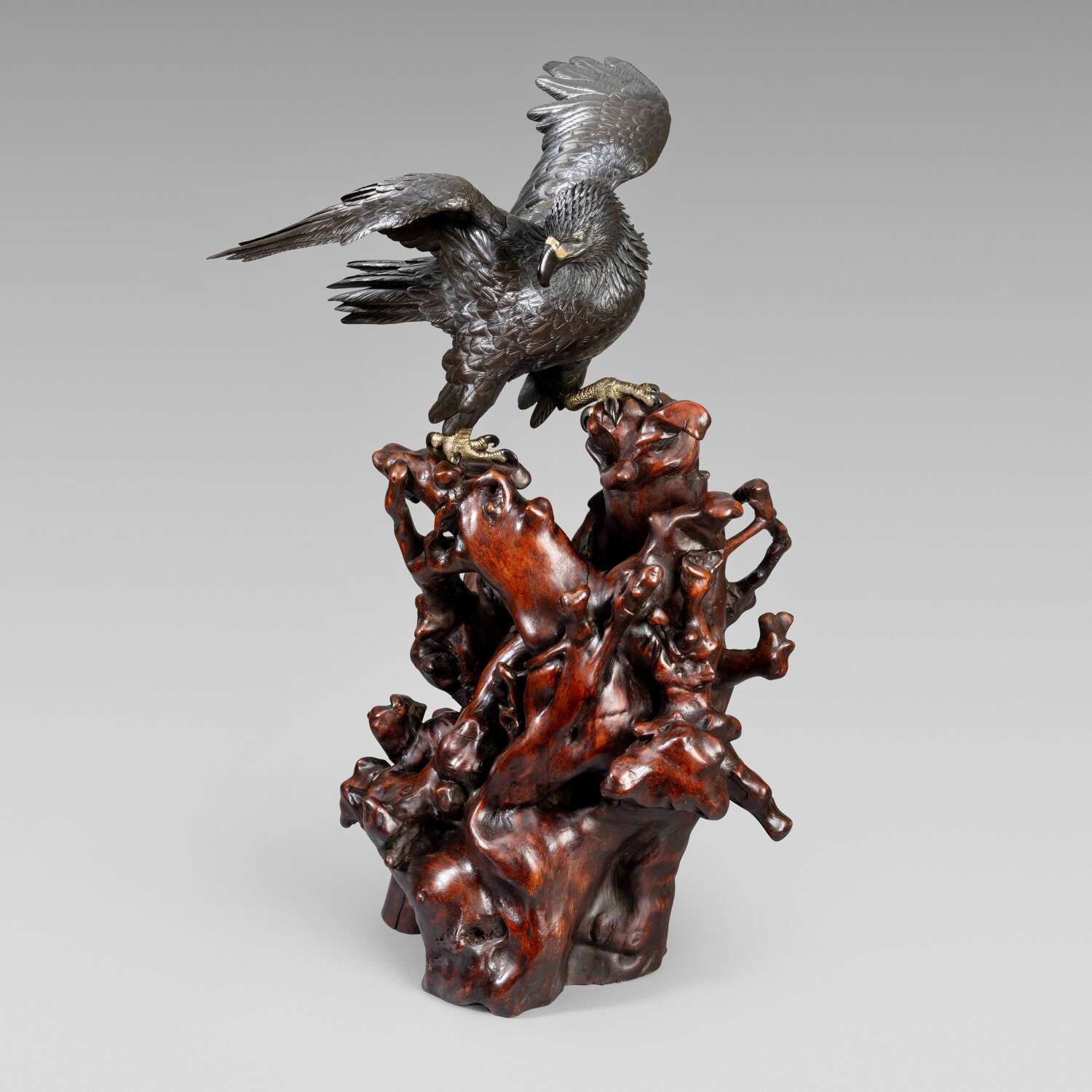
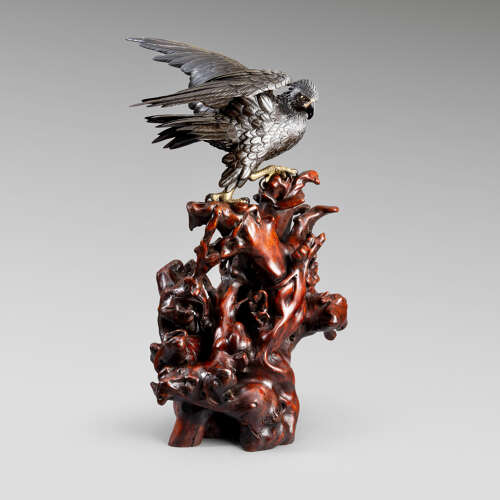
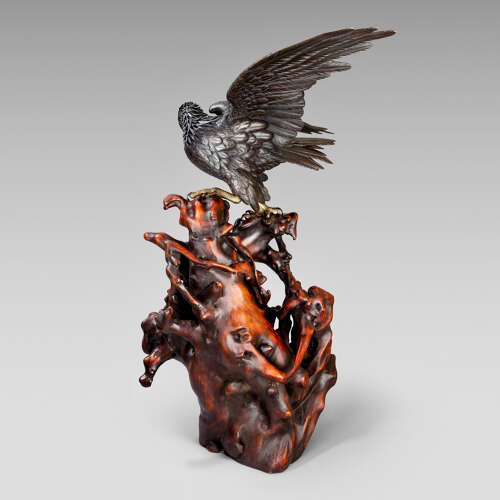
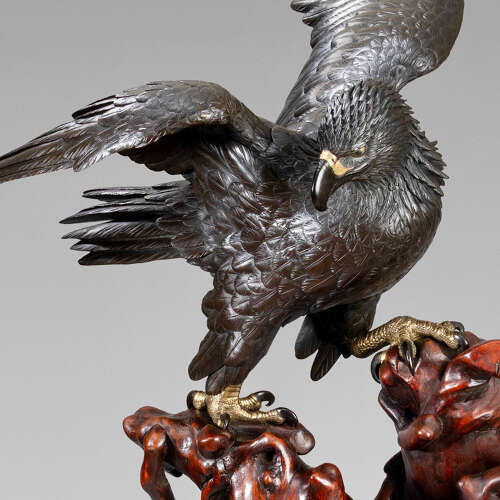
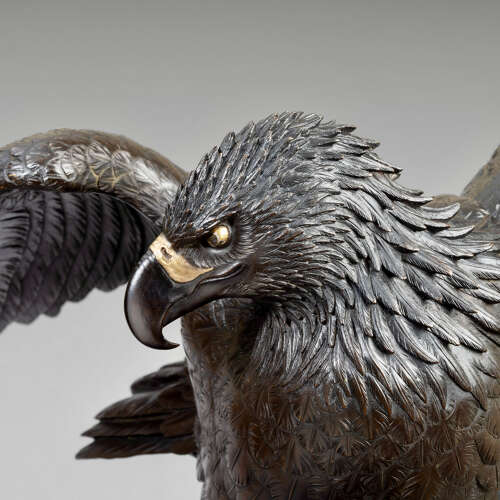
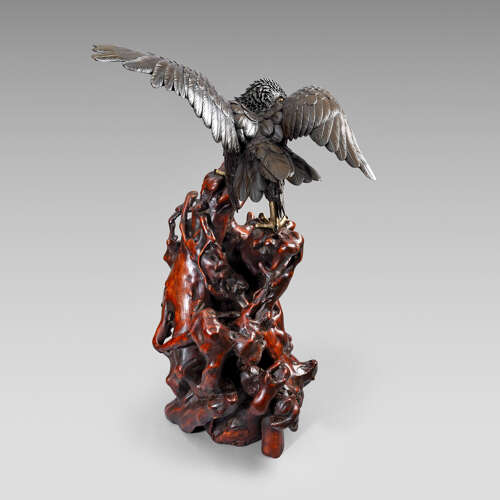
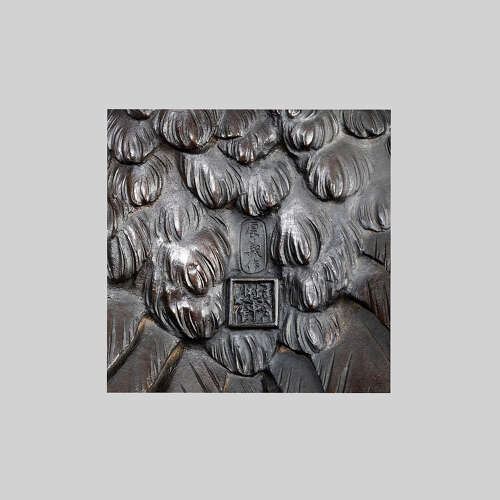
Japanese bronze eagle naturalistically modelled with its wings outstretched in a majestic spread and its head slightly inclined to the side perched on a gnarled root wood tree trunk. The plumage is finely rendered, the talons and eyes are inlaid in shakudō and gilt, adding contrast and intensity to the eagle’s gaze. The sculpture is finished with a rich brown patination, complementing the organic forms of the base. Signed with chiselled characters Atsuyoshi saku 厚義作 with a square plaque Maruki shachu sei まるき製 (made by Miyabe Atsuyoshi for the Maruki Company), Meiji period 1868-1912.
The eagle (washi 鷲), esteemed for its imposing presence and exceptional strength, occupies a prominent place in Japanese artistic symbolism as an emblem of majesty and power. Its symbolic significance closely parallels that of the hawk, with both birds traditionally associated with martial values and warrior culture. Consequently, they featured prominently across a range of artistic media, including sculpture, painting, hanging scrolls, and folding screens. During the Meiji period, representations of eagles and hawks gained particular prominence as visual expressions of samurai ideals, embodying notions of authority, vigilance, strength, and martial supremacy.
Miyabe Atsuyoshi 宮部厚義 worked in Kyoto in the late Edo period and early Meiji era, made fine bronze studies of animals, many of which were commissioned by the Maruki workshop. He is recorded in Wakayama Takeshi 若山猛, Kinko jiten 金工事典 (Dictionary of Metalworkers), Tokyo,Token Shunju Shinbunsha 刀剣春秋新聞社 1999 p.1141.
The Maruki workshop, located on Sukiya Street in the Nihonbashi district of Tokyo, was renowned during the Meiji era for its high-quality bronzes and carvings. The company exhibited widely at both domestic and international expositions, contributing significantly to the global appreciation of Japanese metalwork during this period.
Reference: ' Meiji no Takara 明治の宝 Treasures of Imperial Japan, the Nasser D. Khalili Collection' the Kibo Foundation 1995, Metalwork Part II, no. 93 and no. 103.
‘Splendors of Imperial Japan, Arts of the Meiji Period from the Khalili Collection’, the Kibo Foundation 2002 by J. Earle, p. 274 no. 188.
Dimensions eagle without wood base: H 40cm (15.74 in.) x W 48cm (18.89 in.)
All our pieces come with a BADA Certificate of Provenance (The British Antiques Dealer's Association) and are inclusive of free U.K. shipping & insurance. Please inquiry for International shipping.