

Code: 10301
Dimensions:
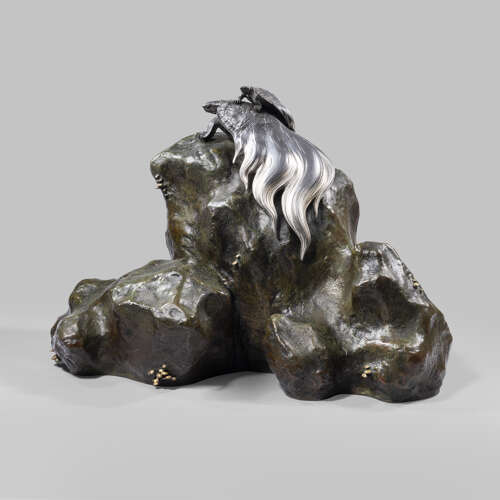
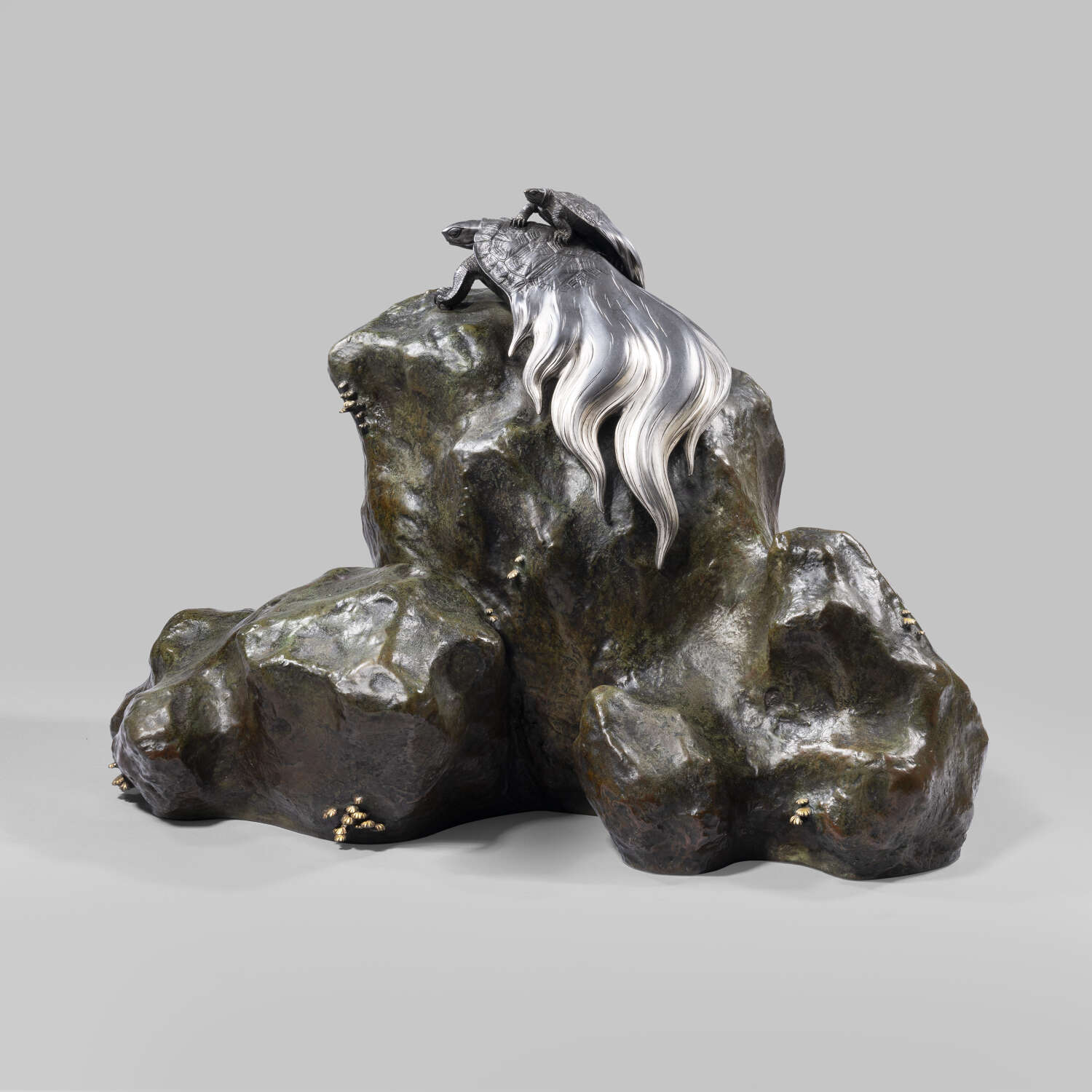
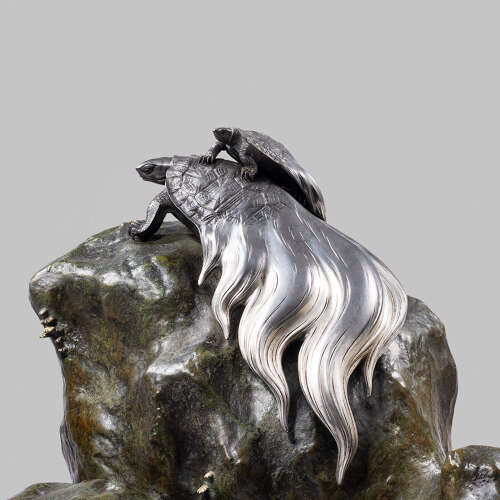
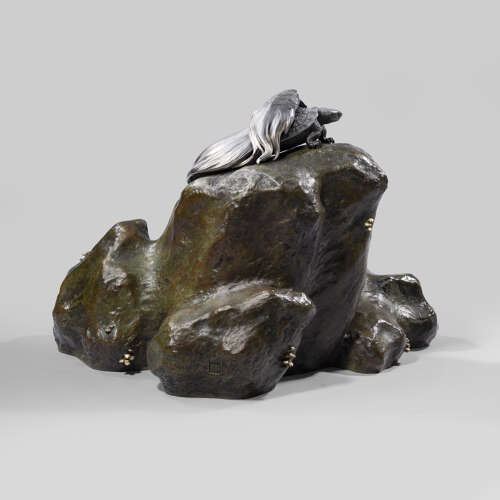
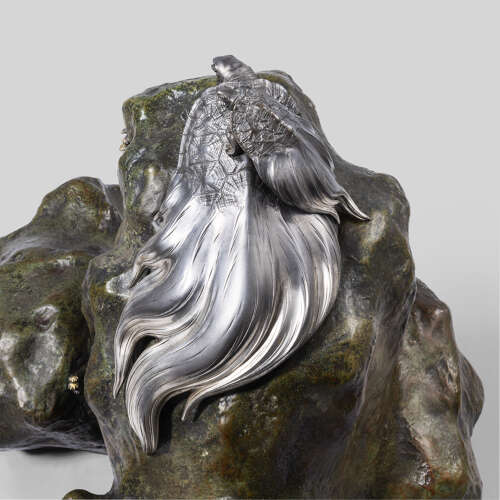
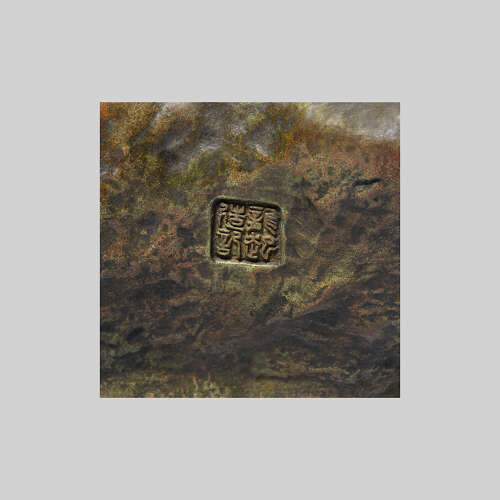
Japanese bronze minogame with silvered feathery tail swept to one side standing atop a naturalistically cast rock base with dark green moss-like patination. The surface is further enriched with gold lichen and fungi motifs subtly integrated into the rocky texture. A juvenile smaller turtle is shown climbing upon its carapace, their shells intricately patterned emphasising realism within a mythological subject. It is signed with chiselled characters on the turtle’s underside Ryūki 龍起 and on the base within a square plaque Ryūki tsukuru shirusu (Ryūki zoki) 龍起造記 (made by and with the seal of Ryūki), Meiji period 1868-1912.
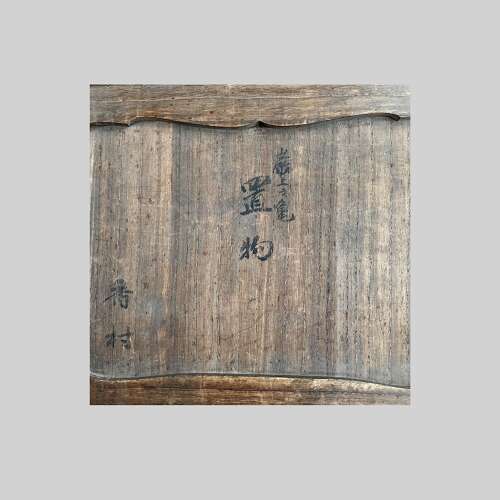
The tomobako wood storage box inscribed: Ganjo no kame, okimono, Koson 巌上之亀, 置物, 香村 (turtles on a rock, okimono, in the collection of Koson).
The artist Nogami Ryūki 野上龍起 (1865-1932) was a graduate from the Tokyo School of Fine Art and exhibited several bronze works of turtles at the 1900 Paris Exposition Universelle. He studied bronze casting under one of the most notable metal craftsmen of the Meiji era, Ōshima Joun 大島如雲, who was a professor at the Tokyo School of Fine Art. He worked for the Imperial Household Agency and was mentioned in the Japanese Art and Artists of Today-V. Metalwork, the Studio 1910. The bronze statue of Kusunoki Masashige near the Imperial Palace and the bronze statue of Saigo Takamori at Ueno Park, both in Tokyo, were also made by Nogami Ryūki.
The minogame 蓑亀 (美濃亀) is a mythical turtle that can live many thousands of years with a long feathery tail made of seaweed, and is a symbol of longevity and happiness.
Reference: for related works see 'The Golden Age of Japanese Okimono: The Dr. Kanter Collection', by Laura Bordignon, ACC Woodbridge 2010, Metalwork no. 242.
All our pieces come with a BADA Certificate of Provenance (The British Antiques Dealer's Association) and are inclusive of free U.K. shipping & insurance. Please inquiry for International shipping.