

Code: 10300
Dimensions:
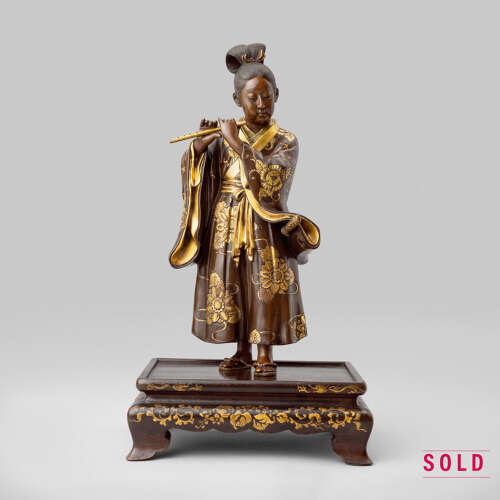
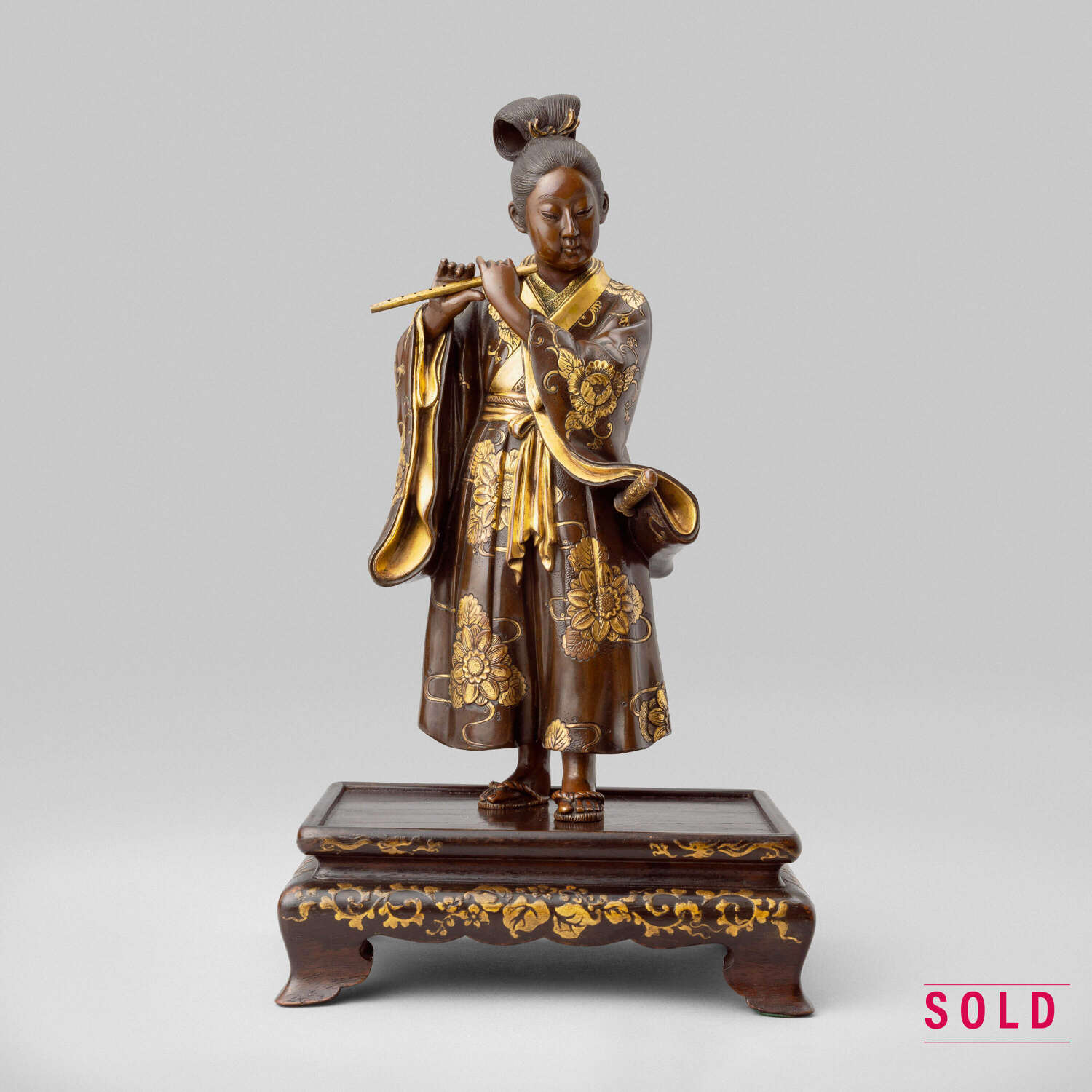
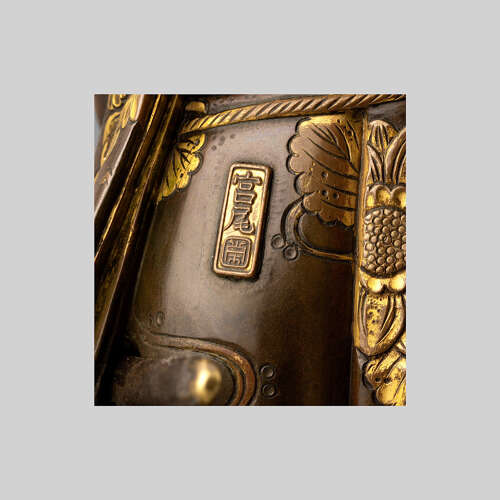
Japanese bronze figure of Fujiwara no Yasumasa playing the flute, depicted as a youthful standing figure with upswept nihongami hairstyle and dressed in a loosely draped kimono, decorated with gilt blossoms and borders. He plays the flute with a contemplative expression, a tachi hangs at his waist. The figure finely worked and finished with a rich brown patination stands on a lacquered hardwood base decorated with hō-ō (phoenix) and foliate scrolls, signed within a rectangular gilt plaque Miyao Ei 宮尾栄助 (Miyao Eisuke), Meiji period 1868-1912.
Fujiwara no Yasumasa (958–1036) was a nobleman of the Heian court, celebrated for his poetry and accomplished flute playing. According to legend, Yasumasa was ambushed one night on the Ichihara moor by the outlaw Hakamadare Yasusuke, who intended to kill him; however, so moved was he by the beauty of Yasumasa’s music that he was unable to draw his sword. This episode became a popular subject in Japanese art and was famously depicted in numerous woodblock prints by Yoshitoshi.
The Miyao Company founded by Miyao Eisuke with premises in Tokyo and Yokohama produced fine bronze sculptures and is also recorded exhibiting carvings in wood in the second National Industrial Exposition (Naikoku Kangyo Hakurankai 内国勧業博覧会) of 1881.The workshop’s output is most often associated with large-scale bronze figures of warriors and subjects drawn from Japanese myth and legend which proved particularly appealing to Western audiences of the period.
Miyao Eisuke captivated foreign markets with the skilful recreations of a Japanese past that was vanishing into memory at the very time these pieces were made.
Reference:' The Golden Age of Japanese Okimono: The Dr. Kanter Collection', by Laura Bordignon, ACC Woodbridge 2010, Metalwork no. 241, 258, 260, 262, 264, 266.
'Meiji no Takara 明治の宝: Treasures of Imperial Japan, the Nasser D. Khalili Collection', the Kibo Foundation 1995, Metalwork Part II, no. 108.
All our pieces come with a BADA Certificate of Provenance (The British Antiques Dealer's Association) and are inclusive of free U.K. shipping & insurance. Please inquiry for International shipping.