

Code: 10298
Dimensions:
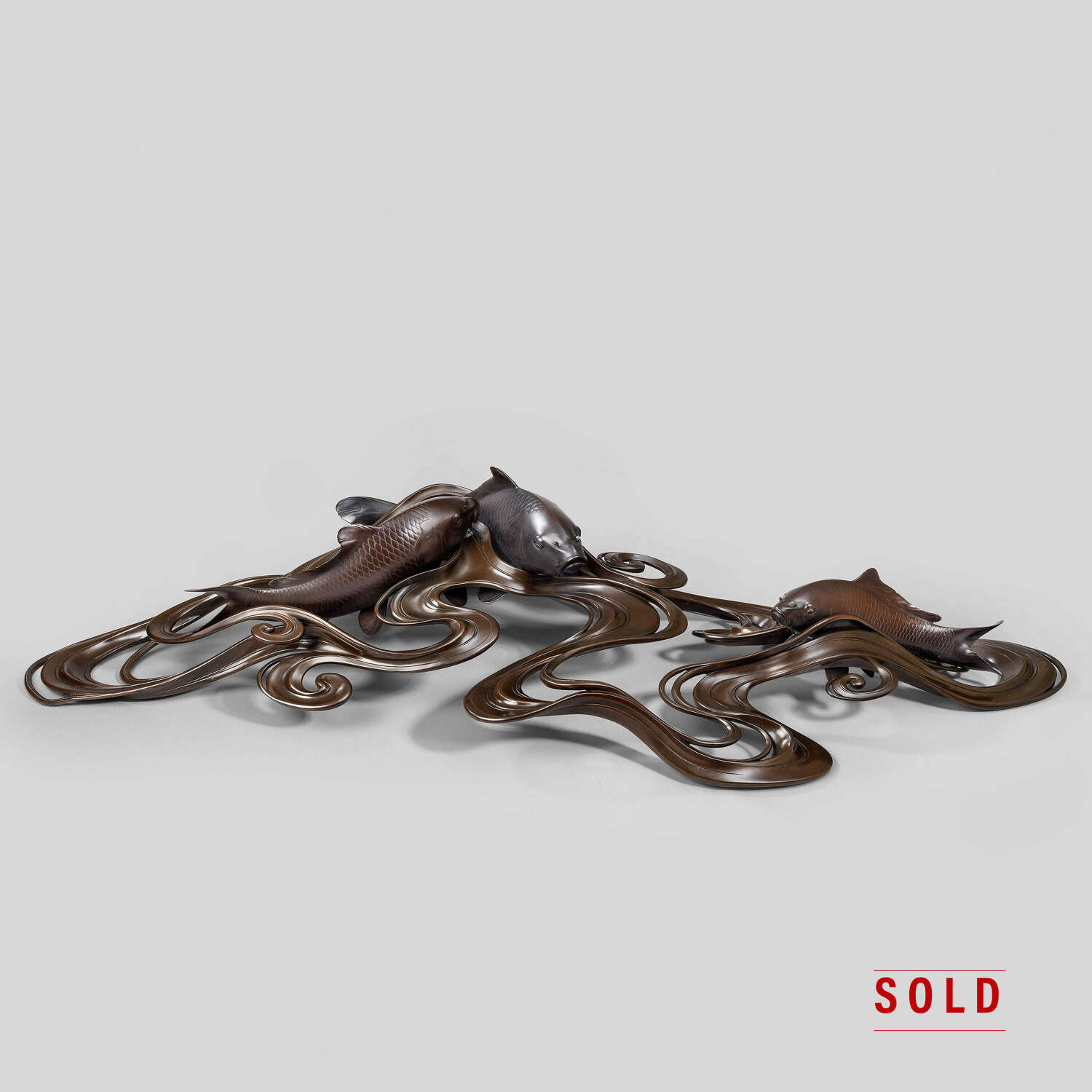
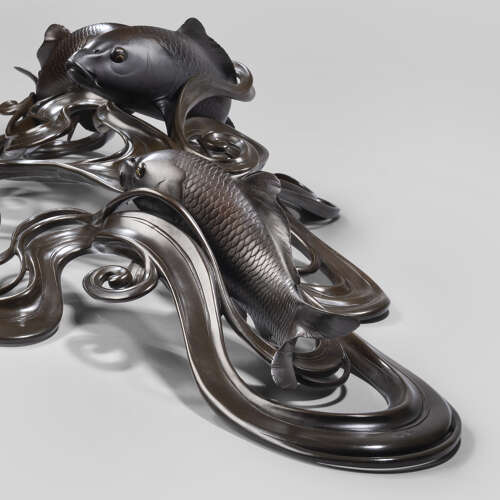
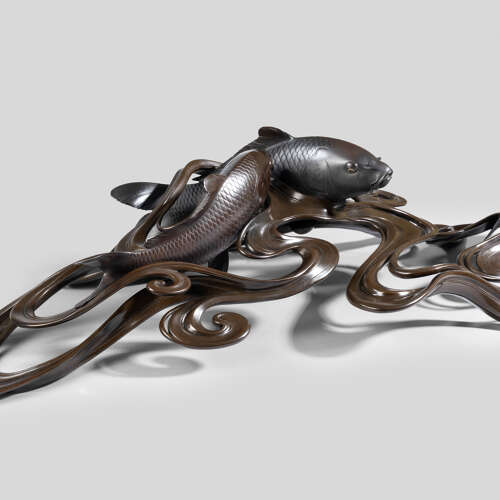
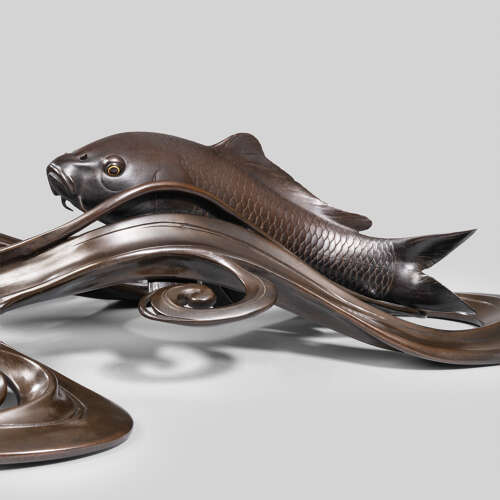
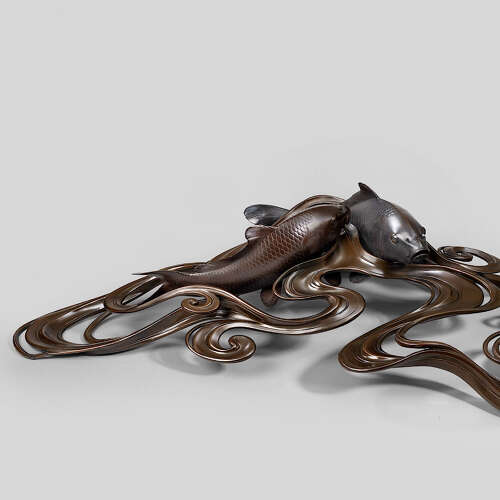
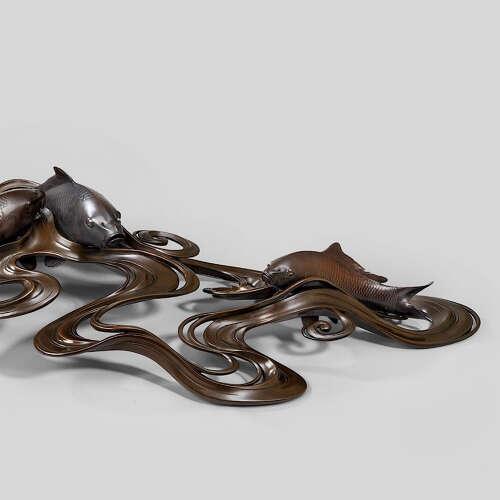
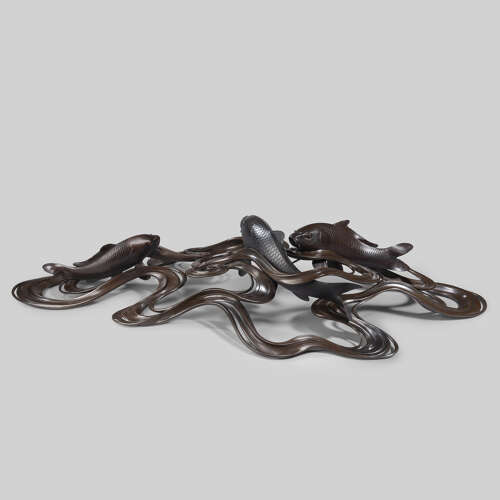
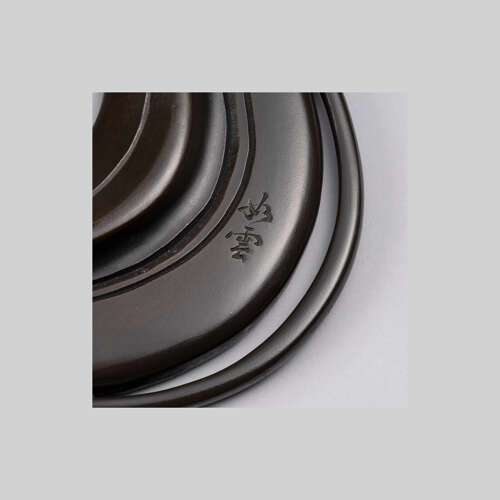
Japanese bronze of three koi carps swimming through stylised and swirling waves. One carp raises its head upward, breaking through the surface, while the others twist and turn alongside it. The scales and fins are finely carved, and the sinuous movement of the fish’s bodies mirror the rolling rhythm of the surging water, creating a dynamic visual tension. The lightly raised tails seem to part the waves, and the flowing wave lines rise and fall with graceful continuity, giving the whole work a refined elegance. This work not only presents the aesthetic beauty of koi carps but also conveys auspiciousness and the spirit of striving forward. The bronze surface has been finely polished with a rich brown patination and the eyes inlaid in shakudō and gold, making the koi carps appear strikingly alive, fully demonstrating the exceptional craftsmanship of Meiji- period metalwork. The piece is signed in chiselled characters Joun 如雲, Meiji period 1868-1912.
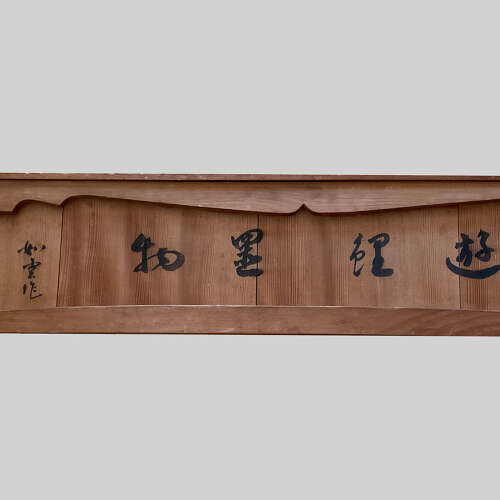
The tomobako wood storage box inscribed: Yuuri okimono (asobu koi), Joun saku 遊鯉置物, 如雲作 (okimono of koi carps swimming leisurely, by Joun). The koi carp (nishikigoi 錦鯉) holds a strong symbolic significance in both Chinese and Japanese cultures, representing perseverance, strength, and the capacity to overcome adversity. This symbolism derives from the legend of the carp leaping over the Dragon’s Gate waterfall (Koi no takinobori 鯉の滝登り) a metaphor for overcoming difficulties and achieving success. It tells the story of thousands koi fish swimming upstream the Yellow River against strong currents, the ones that reach the top of these huge waterfalls transform into dragons.
Ōshima Joun 大島如雲 (1858-1940) was born Katsujirō into a family of metal casters. From childhood he studied casting techniques under his father, Ōshima Takajirō, and mastered the lost-wax casting method. In 1877 Joun inherited the business and adopted the name by which he is known, working under the gō Ichijōken. Within a short period, the workshop expanded under his direction, and by 1879 comprised a team of eleven craftsmen. He also taught at the Tokyo School of Fine Arts (Tōkyō Bijutsu Gakkō 東京美術学校) for forty-two years, instructing in metal casting and wax modelling. His works are characterised by highly detailed craftsmanship regardless of size, with especially graceful and flowing lines. In addition to his expertise in wax casting, he often used inlay techniques, adorning his works with gold, silver, and shibuichi (copper-silver alloy). He was a member of innumerable committees and panels of judges at exhibitions and competitions. Works by the artist are held in the collections of the Tokyo National Museum (Tōkyō Kokuritsu Hakubutsukan 東京国立博物館) Ueno Park, Taitō ward, and the Tokyo National Museum of Modern Art (Tōkyō Kokuritsu Kindai Bijutsukan 東京国立近代美術館).
From 1878 (Meiji 11) he participated in world expositions such as those in Paris, gaining recognition from the Western art world and admiration from collectors. In 1900 (Meiji 33), his work Sparrows among Rice Sheaf 稲穂群雀 won the gold medal at the Paris Exposition Universelle. At the same event he also exhibited a bronze group of Carps swimming (see Fig. 1) which is now in the collection of the Tokyo University of Fine Arts Museum (Tōkyō Geijutsu Daigaku Daigaku Bijutsukan) 東京藝術大学大学美術館 where is regarded as a masterpiece.
This work bears a close resemblance to the piece he exhibited.
Reference: published in 'Meiji Arts - A Consciousness of Inheritance: Selections from the Museum 50 of Taiwan', National Taiwan University Research Center Cultural Heritage Preservation and Development, 2016, pp. 168-170.
'Taiwan 50 Art Museum Collection, Taiwan 50 Art Museum', 2024, pp. 101–102.
All our pieces come with a BADA Certificate of Provenance (The British Antiques Dealer's Association) and are inclusive of free U.K. shipping & insurance. Please inquiry for International shipping.
