Code: 10296
Dimensions:
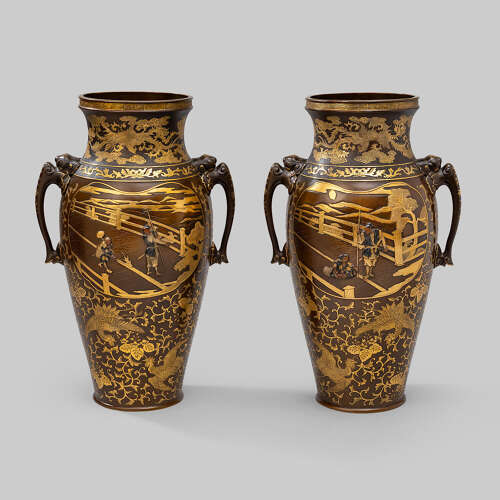
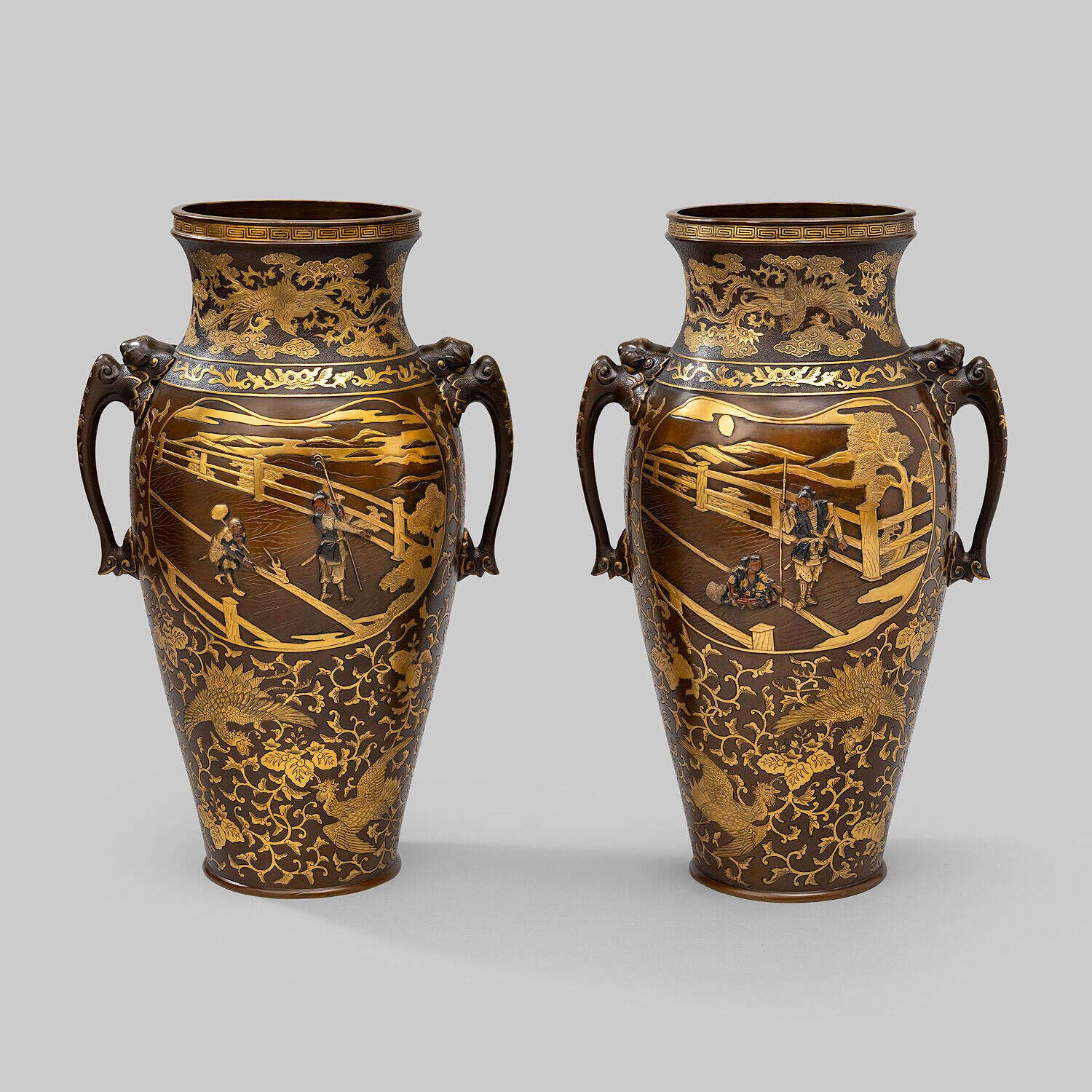
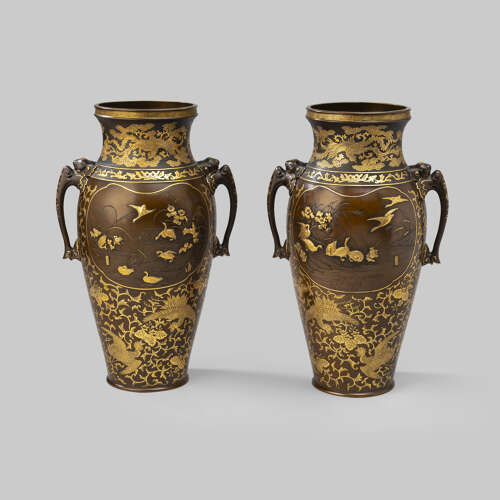
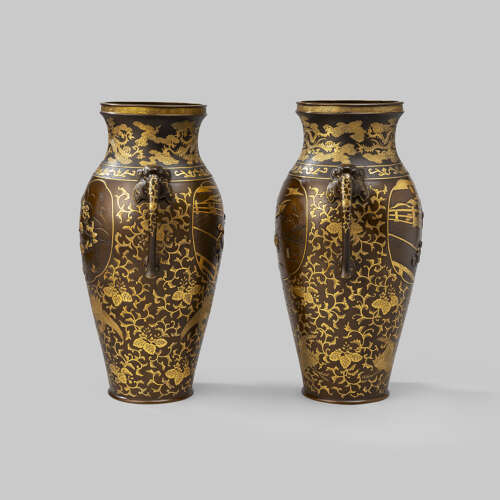
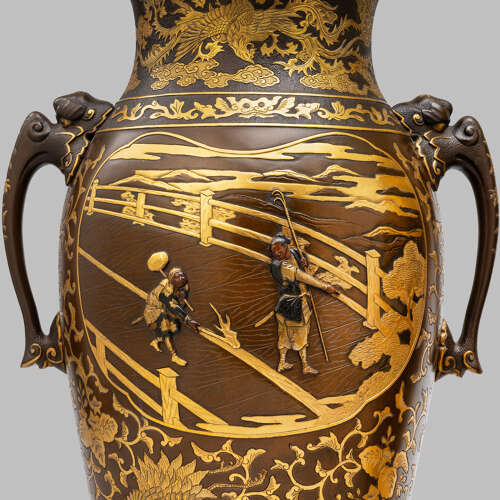
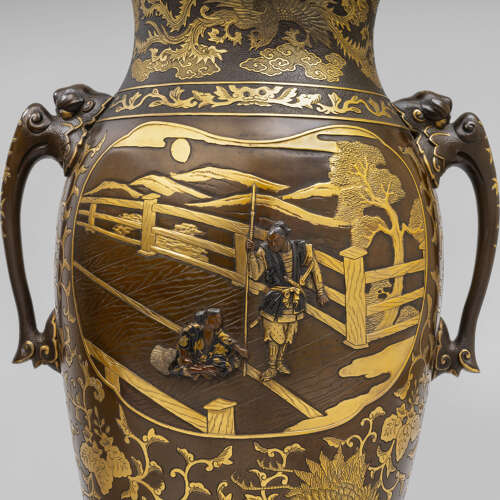
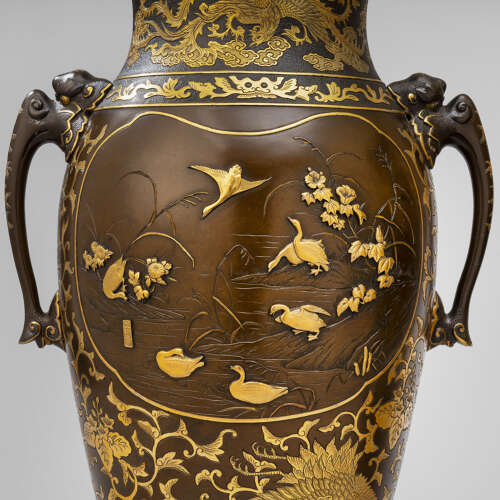
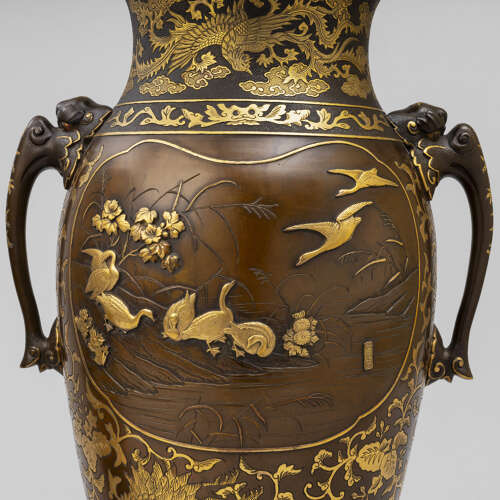
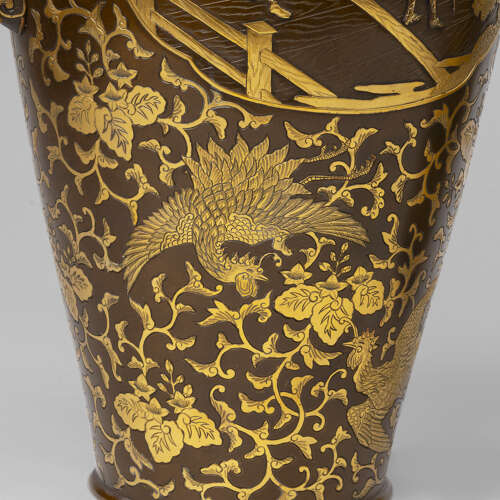
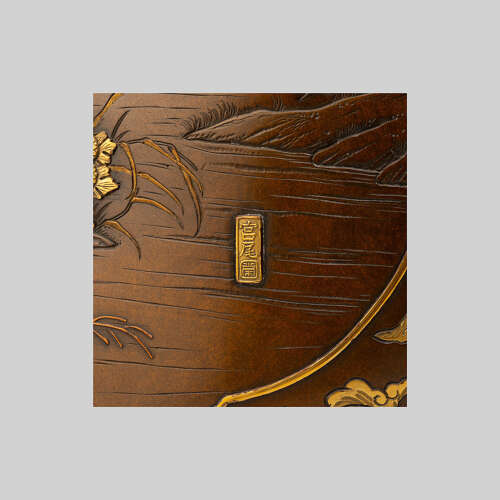
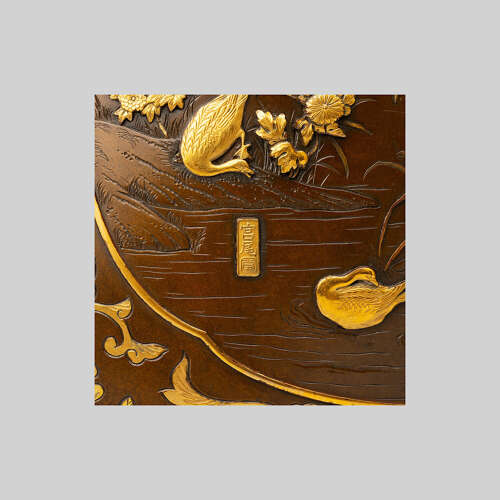
Japanese pair of bronze oviform tapering vases with applied mythical mask handles, finely worked in gold and shakudō on a nanako ground. The lobed panels depict Yoshitsune and other figures standing by the Gojō Bridge, while the reverse presents a serene scene of geese gathered by a reeded stream, with others shown in flight overhead. The bodies and concave necks are richly decorated with hō-ō (phoenix) birds in flight among clouds, rendered in gold and interspersed with trailing leafy tendrils and paulownia blossoms. The rims are encircled by continuous geometric key bands, and each vase is signed within a rectangular gilt plaque Miyao Ei (Miyao Eisuke) 宮尾栄助, Meiji Period 1868-1912.
Minamoto no Yoshitsune 源義経 (1159-1189) ranks among the most celebrated warriors in Japanese history. He later became the subject of enduring legend, appearing prominently in folktales, including the well-known account of his youthful defeat of the giant warrior monk Benkei at Gojō Bridge in Kyoto. He was the general of the Minamoto clan and became a legend because of his bravery and benevolence. Many stories and kabuki plays celebrate the exploits of Yoshitsune especially the literary classic Heike Monotogari, the Tale of the Heiki, the epic struggle between the Heike and Taira clans to seize control of Japan at the end of the 12th century.
The Miyao Company founded by Miyao Eisuke 宮尾柴助 with premises in Tokyo and Yokohama produced fine bronze sculptures and is also recorded exhibiting carvings in wood in the second National Industrial Exposition (Naikoku Kangyo Hakurankai 内国勧業博覧会) of 1881.The workshop’s output is most often associated with large-scale bronze figures of warriors and subjects drawn from Japanese myth and legend which proved particularly appealing to Western audiences of the period. Miyao’s pieces are distinguished by their intricate ornamentation, achieved through meticulous gilding, resulting in finely crafted bronzes with deep, lustrous brown patinas.
Reference: 'The Golden Age of Japanese Okimono: The Dr. Kanter Collection', by Laura Bordignon, ACC Woodbridge 2010, Metalwork no. 241, 258, 260, 262, 264, 266.
'The Dragon King of the Sea: Japanese Decorative Art of the Meiji Period' from the John R.Young Collection, by O. Impey, M. Fairley, Ashmolean Museum Oxford, 1991.
All our pieces come with a BADA Certificate of Provenance (The British Antiques Dealer's Association) and are inclusive of free U.K. shipping & insurance. Please inquiry for International shipping.