Code: 10318
Dimensions:
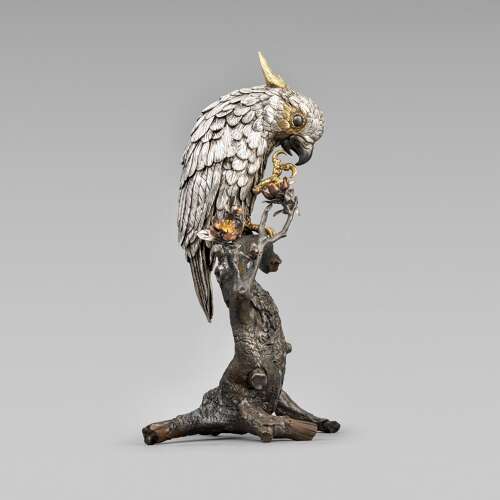
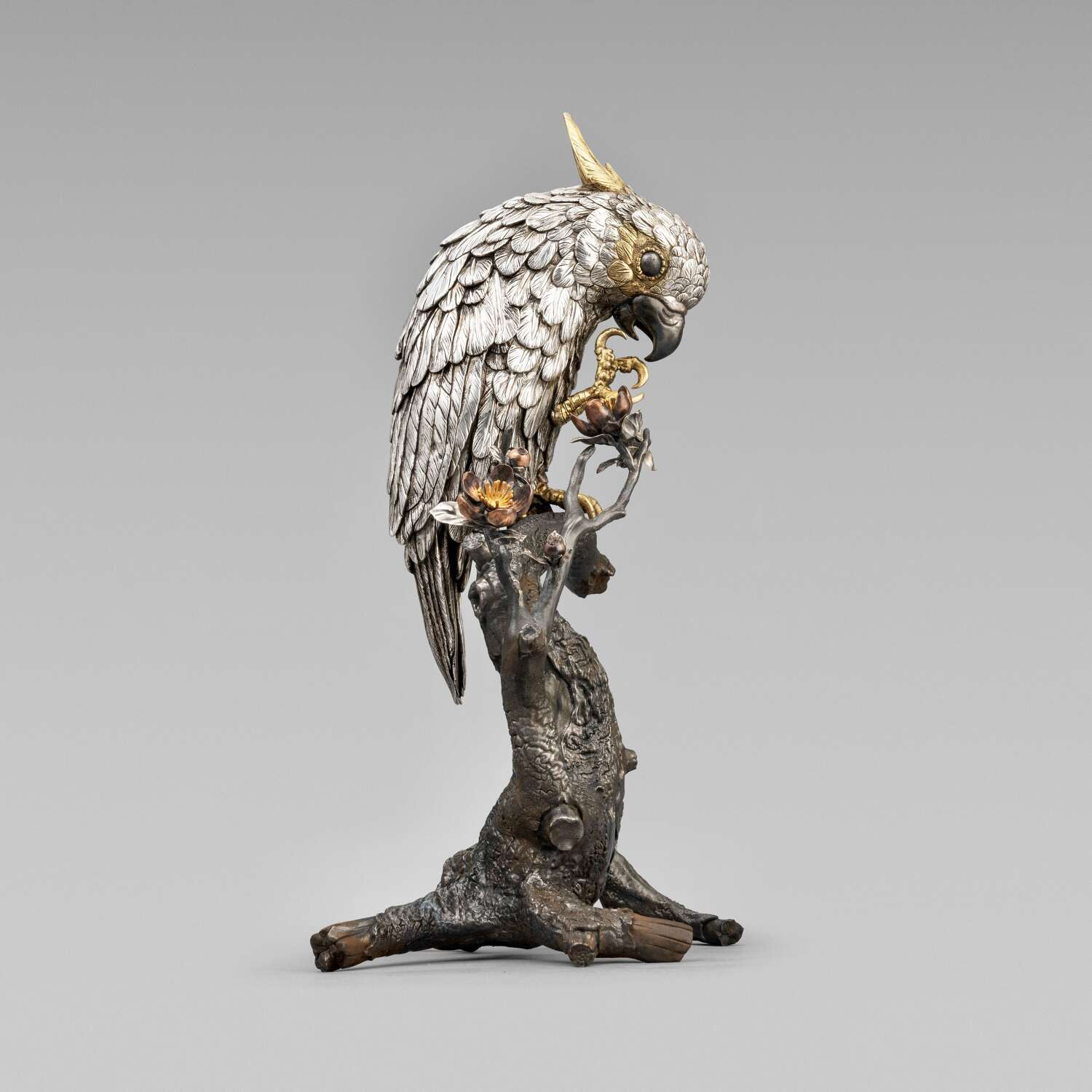
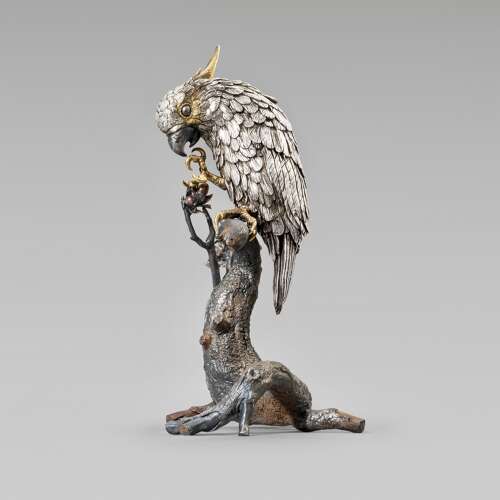
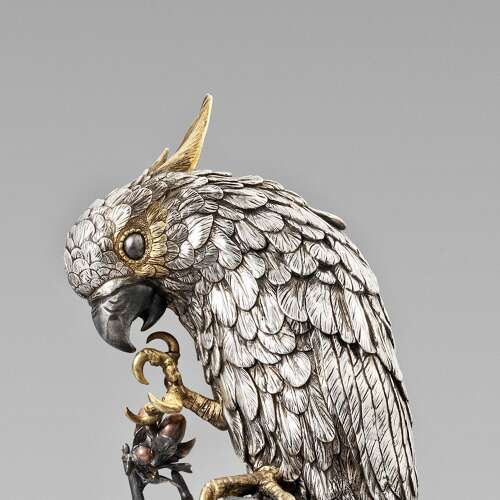
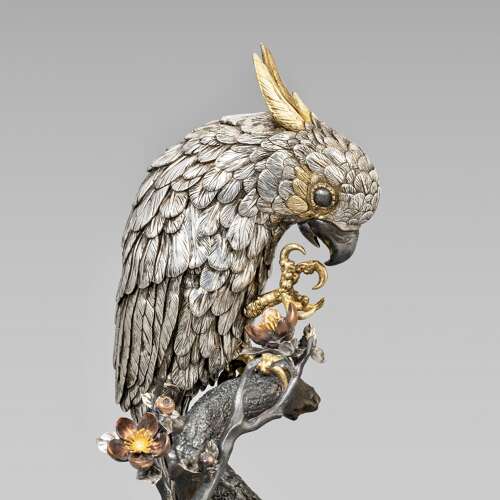
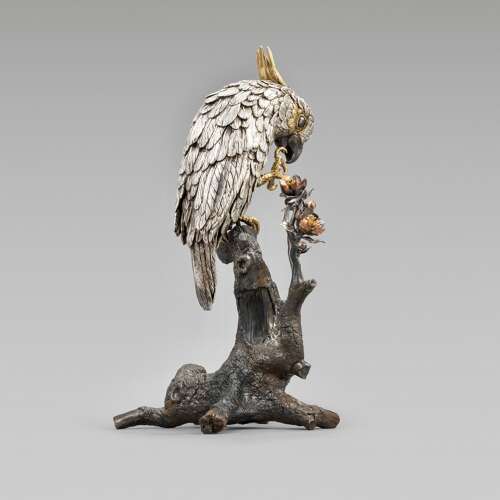
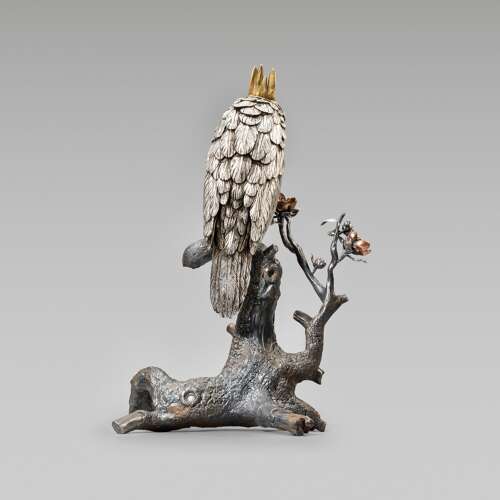
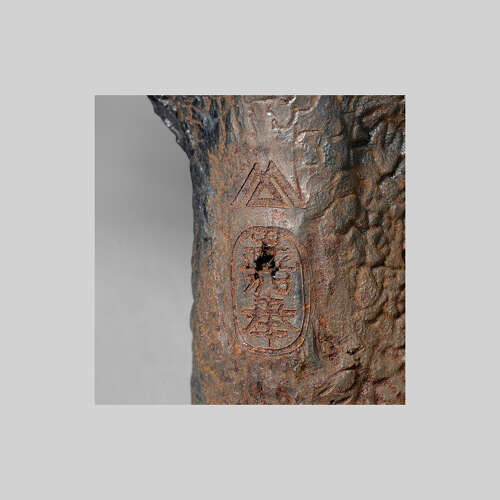
Japanese silver sulphur-crested cockatoo perched gracefully on a flowering plum tree trunk with one talon delicately raised to its beak. Rich gilding highlights the crested feathers, facial markings, and talons, providing a striking contrast to the silver body. The eyes, inlaid in shakudō, and the feather work finely engraved and carved. Signed in an oval reserve Kakō 嘉幸 (Suzuki Chōkichi) with the double-mountain mark of Kiryū Kōshō Kaisha 起立工商会社, Meiji period 1868-1912.
Suzuki Chōkichi 鈴木長吉(1848–1919), known by the art name Kakō, is considered as one of the most distinguished bronze artists of Japan’s Meiji period. Having grown up in Tokyo, he completed a five-year apprenticeship before establishing an independent workshop at the remarkably young age of seventeen, shortly after the onset of the Meiji era. His output encompasses an exceptional range, from refined small-scale works to monumental public commissions. Among the latter are the celebrated bronze incense burners acquired at the Paris Exposition Universelle of 1878 by Sigfried Bing, a Parisian dealer, who later sold it to the Victoria and Albert Museum (Museum Nos.188:1 to 9-1883), which exemplify the technical virtuosity and artistic ambition that distinguished his work. Suzuki rose to prominence as a one of the leading members of the government sponsored export company, the Kiryū Kōshō Kaisha (the Pioneering craft and commerce company), and in 1896 was appointed an Artist to the Imperial Household (Teishitsu Gigei-in) one of the highest artistic distinctions of the period. He was also a prominent participant in the major international expositions held in Vienna World Exposition (1873), Philadelphia Centennial Exposition (1876), and Paris Exposition Universelle (1878), where he won many prizes and his works played a pivotal role in promoting Japanese artistic achievements to Western audiences.
At the 1893 World's Columbian Exposition in Chicago, he exhibited his celebrated Twelve Hawks, a work that received considerable critical acclaim and it today preserved in the collection of the Tokyo National Museum of Modern Art.
Reference: ’Meiji no Takara 明治の宝: Treasures of Imperial Japan, the Nasser D. Khalili Collection', the Kibo Foundation 1995, Metalwork Part I, no. 2.
‘Kiritsu Kosho Kaisha kogei shitazushu’ by Hida Toyojiro (Kyoto Shoin 1987).
Weight: 1019 grams (35.94 oz)
Dimensions of the cockatoo without the base: H 23 cm (9.05 in.) x W 7cm (2.75 in.)
All our pieces come with a BADA Certificate of Provenance (The British Antiques Dealer's Association) and are inclusive of free U.K. shipping & insurance. Please inquiry for International shipping.