Code: 10266
Dimensions:
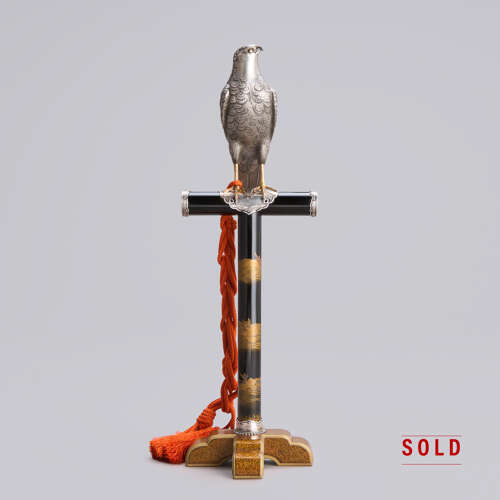
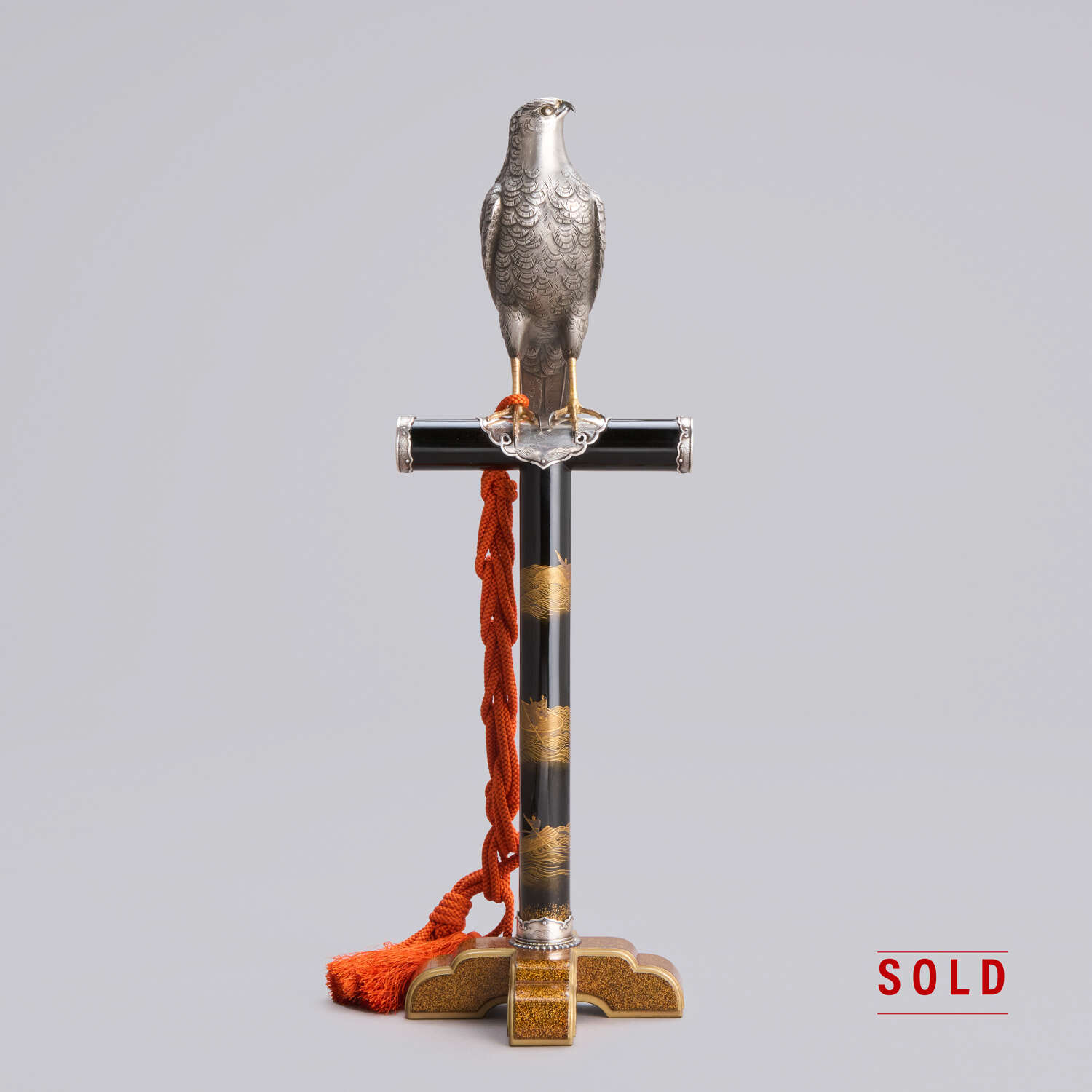
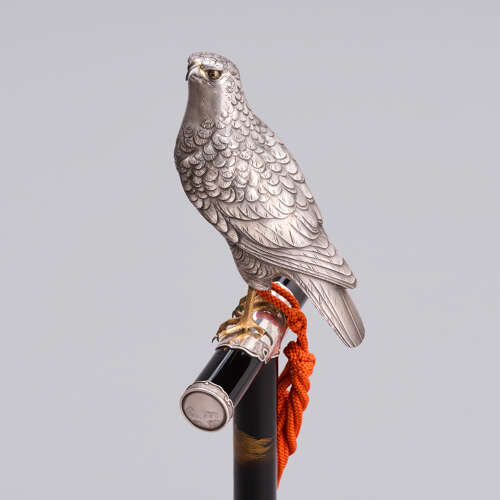
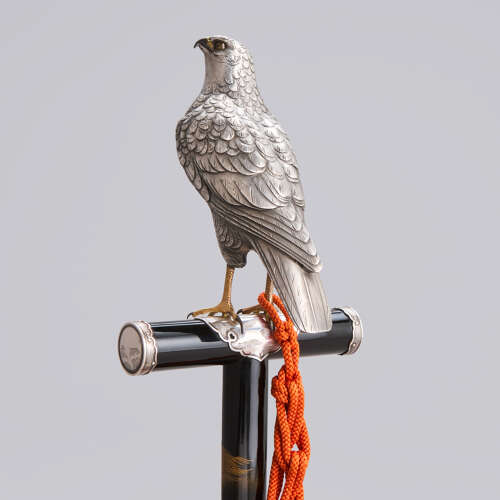
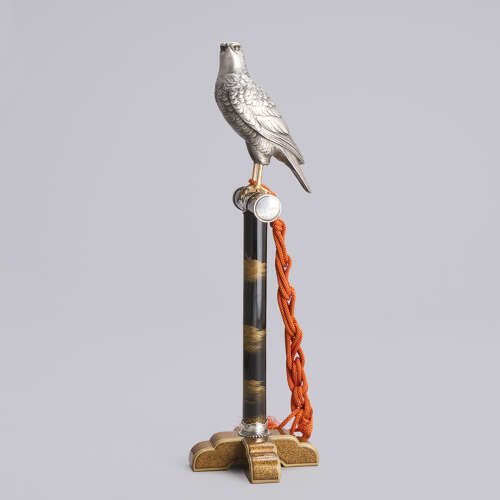
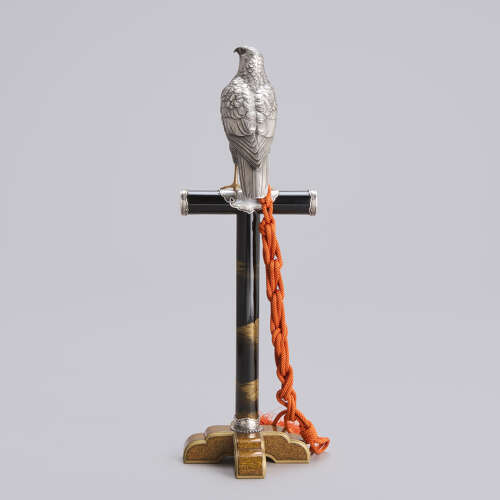
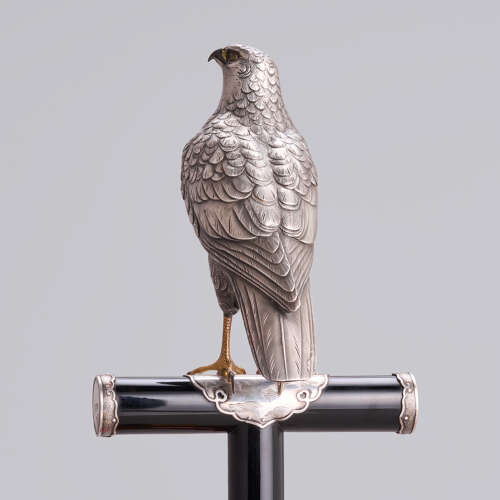
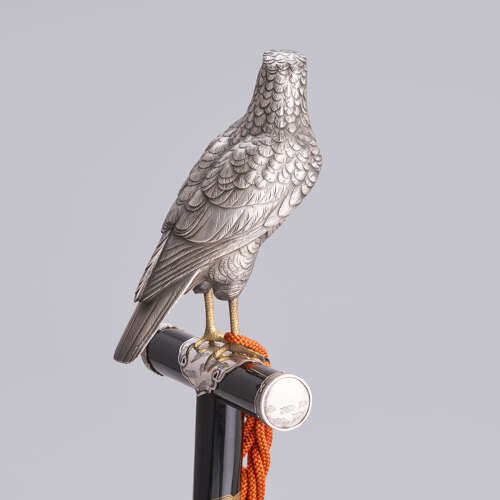
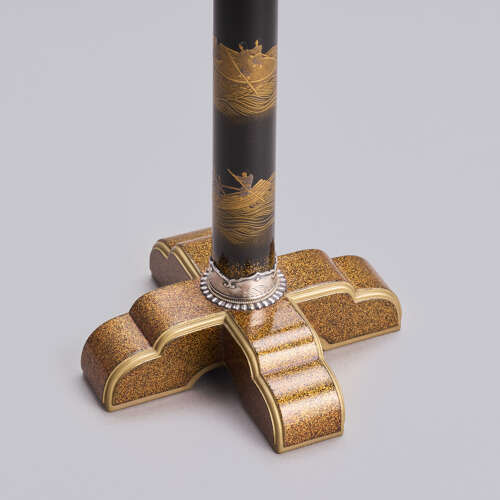
Japanese silver hawk perched on a black lacquer stand exquisitely worked in gold hiramakie, takamakie and nashiji.The stand is richly decorated with seamen on boats navigating crashing waves, a dynamic maritime motif rendered in traditional Japanese lacquer techniques.
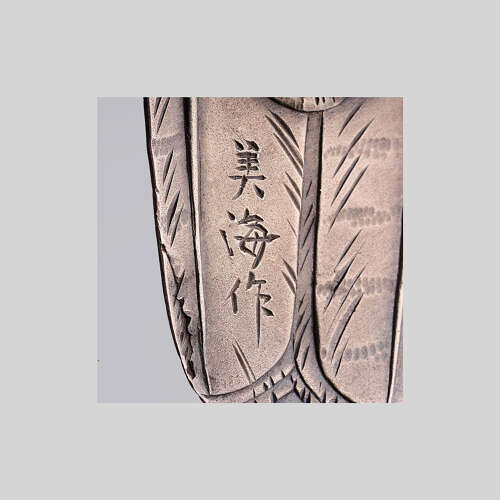
The feather work finely engraved, with eyes and talons in shakudo and gold signed in chiselled characters beneath the tail Bikai saku 美海作 (made by Bikai), Taishō period (1912-1926).
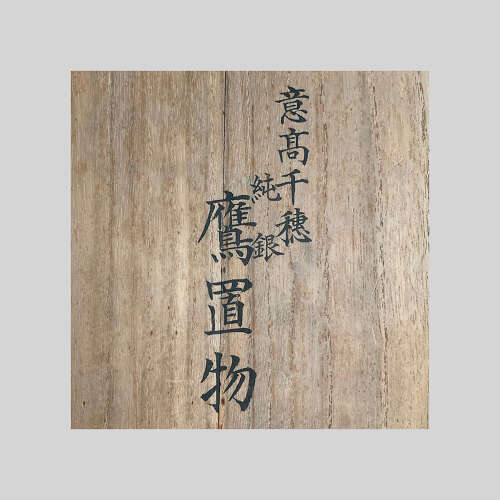
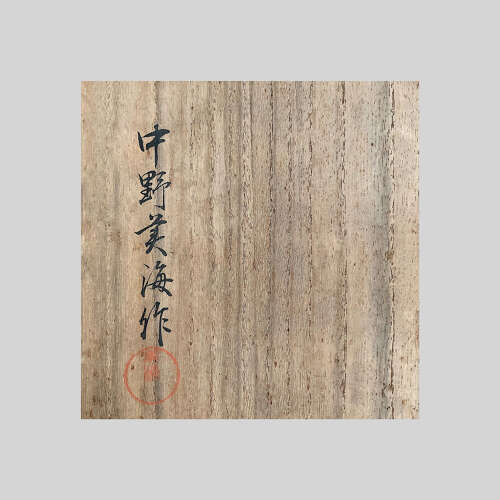
The tomobako wood storage box inscribed Takachiho o ishite, jungin, taka okimono, Nakano Bikai saku, with the seal Bikai 意高千穂, 純銀, 鷹置物. 中野美海作 (the hawk named Takachiho, pure silver, an okimono made by Nakano Bikai, with the seal Nakano).
There is an historical connection to this piece as the artist identified the hawk named Takachiho by an inscription on the original tomobako wood storage box. In 1985 during the Sino-Japanese War, the Imperial Navy ship Takachiho won the battle of the Yellow Sea. A hawk reportedly landed on the top of the mast of the ship. Seen as a portent of victory, the bird was later gifted to Emperor Meiji, who named it "Takachiho" and kept it in his Shinjuku Imperial Garden aviary. The work thus carries deep national and symbolic meaning.
The artist Nakano Bikai 中野美海 worked in Osaka for the Yamaguchi Kikin Gomei Company. He contributed to prestigious commissions including projects for the Osaka Mint Office. He was also a teacher of Takagi Jirobei IV, an iron kettle maker for the tea ceremony, and remained active at least until 1924, when he made the commemorative coin for the wedding of Crown Prince Hirohito who became Emperor Shōwa in 1926.
The hawk (taka 鷹) is an auspicious symbol of strength, courage and nobility. The tradition of falconry (takagari 鷹狩) was a favourite past time of the nobility and the Samurai class to show their wealth and status.
Hiramakie 平蒔絵 a flat sprinkled lacquer technique where the design is raised above the ground only by the thickness of its coats of lacquer.
Takamakie 高蒔絵 a high sprinkled lacquer technique where the lacquer is built up by applying many layers.Togidashie: the design is executed in lacquer and subsequently dusted with gold or silver powder. Once the lacquer has dried, another lacquer layer is applied over the motif to fix the metallic powder in place.
Nashiji 梨子地 irregular flakes of gold or silver sprinkled in clear or yellowish lacquer.
Reference: for a similar work see 'Eaglemania: Collecting Japanese Art in Gilded Age America', exhibition catalogue, Boston, McMullen Museum of Art, Boston College, 2019, p.97.
All our pieces come with a BADA Certificate of Provenance (The British Antiques Dealer's Association) and are inclusive of free U.K. shipping & insurance. Please inquiry for International shipping.